
In home services a no-show costs more than an empty appointment slot. It costs drive time, fuel, a paid technician hour, and the job you could have booked instead. The single biggest cause is not forgetfulness. It is arrival windows so wide that customers give up waiting.
Why home service no-shows are a different problem
Nearly every article on reducing no-shows is written for medical practices, dental offices, and salons. In those businesses the customer travels to you. When they do not show, you have an empty chair and idle staff, which are real costs but contained ones.
Field service inverts this. Your technician drives to their house. When nobody is home you have paid for:
- The technician's time for the visit and the round trip.
- Fuel and vehicle wear.
- A slot in the day's route that could have held a paying job.
- The scheduling knock-on if the route has to be resequenced.
- Sometimes materials loaded for a job that did not happen.
That changes which fixes matter. The clinic playbook is heavy on reminders and cancellation policies. Those help, but they do not address the cause that dominates in the trades, which the clinic literature has no reason to consider, because clinics give appointment times and field businesses give windows.
What a no-show costs
Technician hourly cost (loaded wage, say $45) × hours consumed (1.5 including travel) = $67.50
Vehicle cost, fuel and wear, roughly $20 on an average round trip.
Displaced job, since the slot could have carried your average ticket at your booking rate. On a $450 average ticket, call it $225 to $450.
Total: roughly $300 to $540 per no-show, most of it in the job that did not get done rather than in the visit that did.
Illustrative figures. Run the arithmetic with your own loaded labor rate, vehicle cost and average ticket before quoting it to anyone.
At even three no-shows a week, that is a meaningful annual number, and unlike most revenue leaks this one is largely preventable with process rather than spend.
- A field service no-show costs several hundred dollars, most of it in the displaced job rather than the wasted trip.
- Wide arrival windows cause more no-shows than forgetfulness does.
- The highest-value message in the sequence is the en-route notification, which almost no general guide mentions.
- Confirmation requests outperform passive reminders, because a reply commits the customer.
- Diagnostic fees and deposits both work, but on different job types and for different reasons.
Fix the arrival window first
This is where the trades diverge sharply from the standard advice, and it is the thing to address before touching your reminder sequence.
A customer told "sometime between 8 and 12" has to write off a morning. Many will. Some will take the risk, wait until 11, conclude you are not coming, and leave for an errand, arriving back to a missed-call notification and a technician who logged them as a no-show. From your side that is a customer who did not honor the appointment. From theirs it is a company that did not turn up in three and a half hours.
What actually reduces this:
1. Narrow the window. Two hours is materially better than four. If routing makes that hard, narrow it the day before once the route is set.
2. Confirm the window the evening before, not just the day of. This is when the customer decides whether to rearrange their morning.
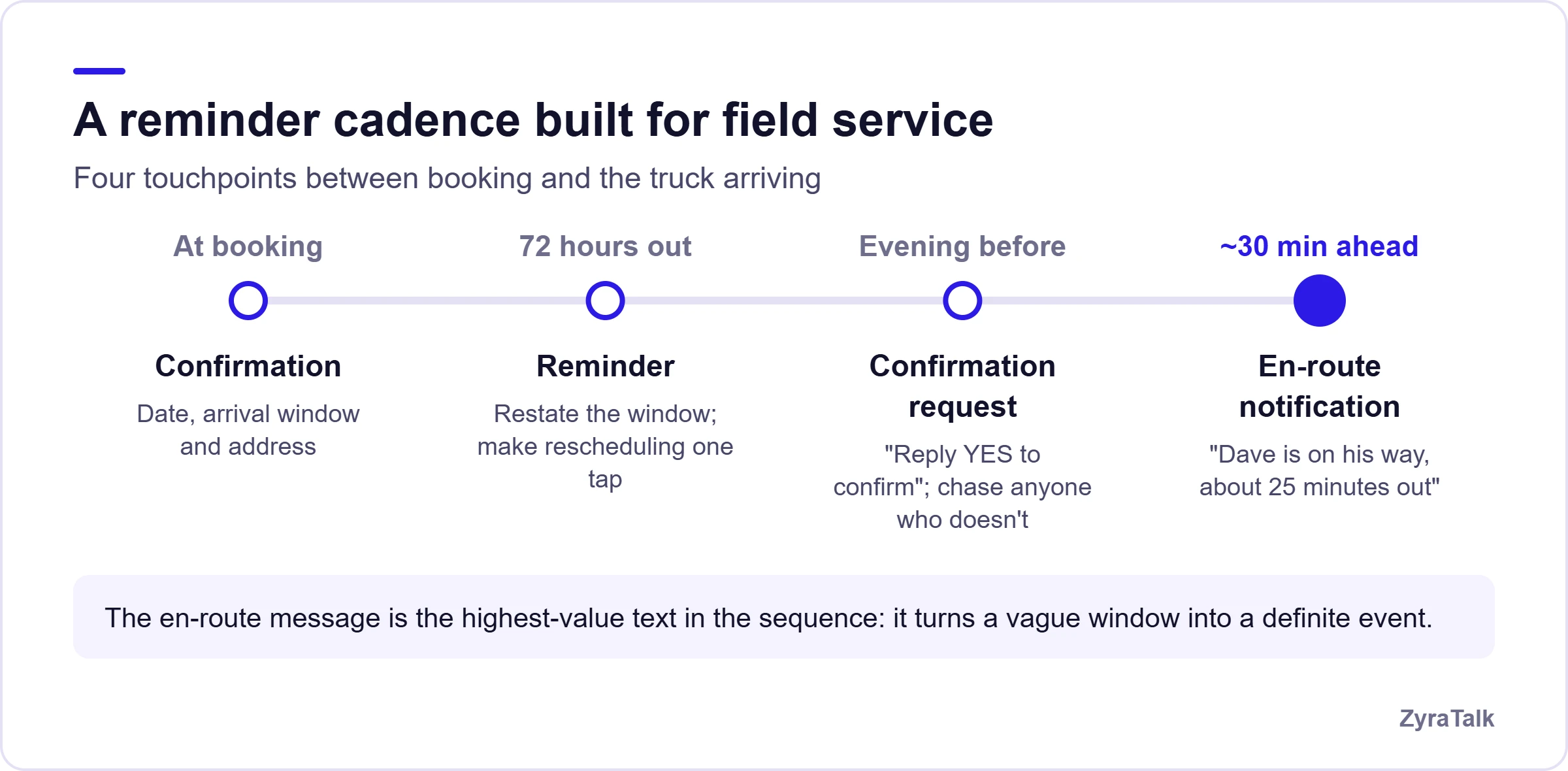
3. Send the en-route notification. "Dave is on his way, about 25 minutes out." This single message does more than any other in the sequence. It converts a vague window into a definite event, and it catches the customer who was about to step out.
4. Call if you are running late, before the window closes. A customer told at 11:30 that the tech is running to 1pm will usually accommodate. A customer who works it out from silence will not.
The reminder cadence for field service
The commonly recommended sequence is 72 hours, 24 hours, and 2 hours before. That is a reasonable base, but it is built for a customer travelling to a fixed appointment time. For field service, adapt it:
Two design notes that matter more than the timing:
- Ask for a confirmation reply, not just acknowledgment. "Reply YES to confirm" produces a small commitment and, more usefully, gives you a list of unconfirmed appointments to chase before the truck rolls.
- Make rescheduling one tap. The counterintuitive finding across the research is that making cancellation easier reduces no-shows, because the alternative to an easy reschedule is not attendance. It is silence.
Deposits and diagnostic fees
General guides recommend deposits as a no-show deterrent. In home services this needs splitting into two different tools.
Diagnostic fees on service calls
A modest fee, commonly in the $79 to $129 range, charged for the visit and credited against the repair if the customer proceeds. Its main function is not revenue. It is commitment. A customer who has agreed to a diagnostic fee is measurably more likely to be home. It also filters price-shoppers who were never going to book.
Deposits on quoted replacement work
For larger jobs such as system replacements, roofing and remodels, a percentage deposit is standard and serves a different purpose: it secures scheduling and covers materials. Requiring one on a $400 service call will cost you bookings; requiring one on a $9,000 replacement is expected and protects you.
The mistake is applying one policy to both. Match the friction to the job value.
A cancellation policy that is actually enforceable
Policies only work if they are communicated at booking and applied consistently. A workable structure:
- State it at booking, in the confirmation message, and in the reminder, not buried on your website.
- Give a clear notice period, typically 24 hours.
- Specify the consequence, and make it proportionate. A modest trip fee is enforceable and defensible; an aggressive penalty generates disputes and bad reviews for marginal recovery.
- Enforce it consistently but keep discretion for genuine emergencies. Waiving a fee for a customer whose child was sick buys more than the fee is worth.
Track the reason, not just the rate
Most businesses record no-shows as a single count. The reason code is where the fix comes from. Even a rough four-way split tells you what to work on:
- Not home or gave up waiting points at the arrival window and en-route messaging.
- Forgot points at the reminder cadence.
- Cancelled but not recorded points at an intake and dispatch communication failure, not a customer problem.
- Changed mind or got another quote points at speed and the pricing conversation at booking.
The distribution usually surprises owners. The first category is typically larger than expected and the second smaller, which means the reminder sequence everyone reaches for first is often not the binding constraint.
How ZyraTalk helps
ZyraTalk contributes on the booking side of the problem rather than the reminder side. Because it books directly into your field service software during the call, the appointment details, including window, address and access notes, are captured accurately at the point of booking rather than transcribed later, which removes a common source of confusion. It also handles reschedule requests when they come in by phone after hours, so a customer who needs to move an appointment at 9 p.m. can do so instead of simply not being home.
Reminders help. But if you take one thing from this article, narrow the arrival window and send the en-route message. In field service those two changes address the cause that the standard advice was never written to see.
Catch the reschedule before it becomes a no-show
ZyraTalk answers after-hours calls for HVAC, plumbing, electrical, cleaning and painting businesses, captures the booking accurately first time, and lets customers move an appointment at 9 p.m. instead of just not being home.
Book a demo- Accurate windows and access notes at booking
- After-hours reschedules handled
- Writes straight into your schedule
Reducing no-shows FAQs
What causes most no-shows in home services?
Arrival windows that are too wide. A customer given a four-hour window frequently gives up waiting and steps out, which is recorded as a no-show but caused by scheduling. Forgetfulness, the usual first suspect, is generally a smaller share.
How many reminders should I send?
Three to five across the booking window: confirmation at booking, a reminder 72 hours out, a confirmation request the evening before, and an en-route notification 30 minutes ahead. The en-route message is the highest value of the set.
Should I charge a fee for no-shows?
A modest trip fee is defensible if communicated at booking and applied consistently. For service calls, a credited diagnostic fee usually works better than a punitive no-show charge, because it secures commitment upfront rather than trying to recover after the fact.
Does making it easy to cancel increase cancellations?
It increases recorded cancellations and reduces no-shows, which is the trade you want. A cancelled slot can be refilled; a no-show cannot, because you find out when the technician is standing at the door.
What's a normal no-show rate?
Published figures come mostly from healthcare and do not transfer well to field service. Track your own rate and, more importantly, your own reason codes, since the distribution tells you which fix applies.
Do deposits reduce no-shows?
Yes, and they filter non-serious bookings. Match the friction to the job value: a credited diagnostic fee on service calls, a percentage deposit on quoted replacement work. Requiring a large deposit on a small job costs you more in lost bookings than it saves.