
A missed call costs you the job you would have booked, multiplied by the odds you would have booked it. For most home service businesses that lands between a few hundred and several thousand dollars per missed call once repeat work is counted. The arithmetic below runs on four numbers you already have, so you get your figure instead of a borrowed statistic.
Why the statistics you have seen are not useful
Search this topic and you will find a wall of alarming figures: that small businesses miss some large percentage of calls, that most callers never leave a voicemail, that billions in revenue evaporate annually. Follow the citations and something uncomfortable emerges. Most of these numbers trace back to another vendor blog, which cites a third, which cites the first. Very few lead to a primary study with a stated methodology.
That does not make the underlying problem imaginary. It makes borrowed numbers a bad basis for a decision about your business. The alternative is to calculate your own, which takes about twenty minutes.
The calculation
For the monthly figure, multiply that result by your missed calls per month.
You need four numbers, and you already have three of them.
1. Your missed calls per month
Pull thirty days from your phone carrier's call log or your call tracking software. Count total inbound and unanswered. This number is usually the surprise, because most owners estimate low: the calls they never knew about are by definition invisible.
2. Your booking rate
Of the calls you do answer, what share become scheduled jobs? If you answered 300 calls and booked 150, that is 50%. This is the right multiplier because a missed call was not a guaranteed job. It was a call with the same odds as any other.
3. Your average ticket
Total revenue divided by completed jobs. Use a segmented figure if your work varies widely; a blended average across $200 service calls and $9,000 replacements will distort the result.
4. Your recovery rate
The share of missed callers who call back, leave a voicemail you convert, or respond to a text-back. This is the number every vendor article omits, because including it makes the headline smaller. Include it anyway, since a defensible number persuades better than an inflated one. If you have no data, 10–20% is a conservative working assumption for a business with no text-back system, and you should replace it with real data as soon as you can.
Worked example
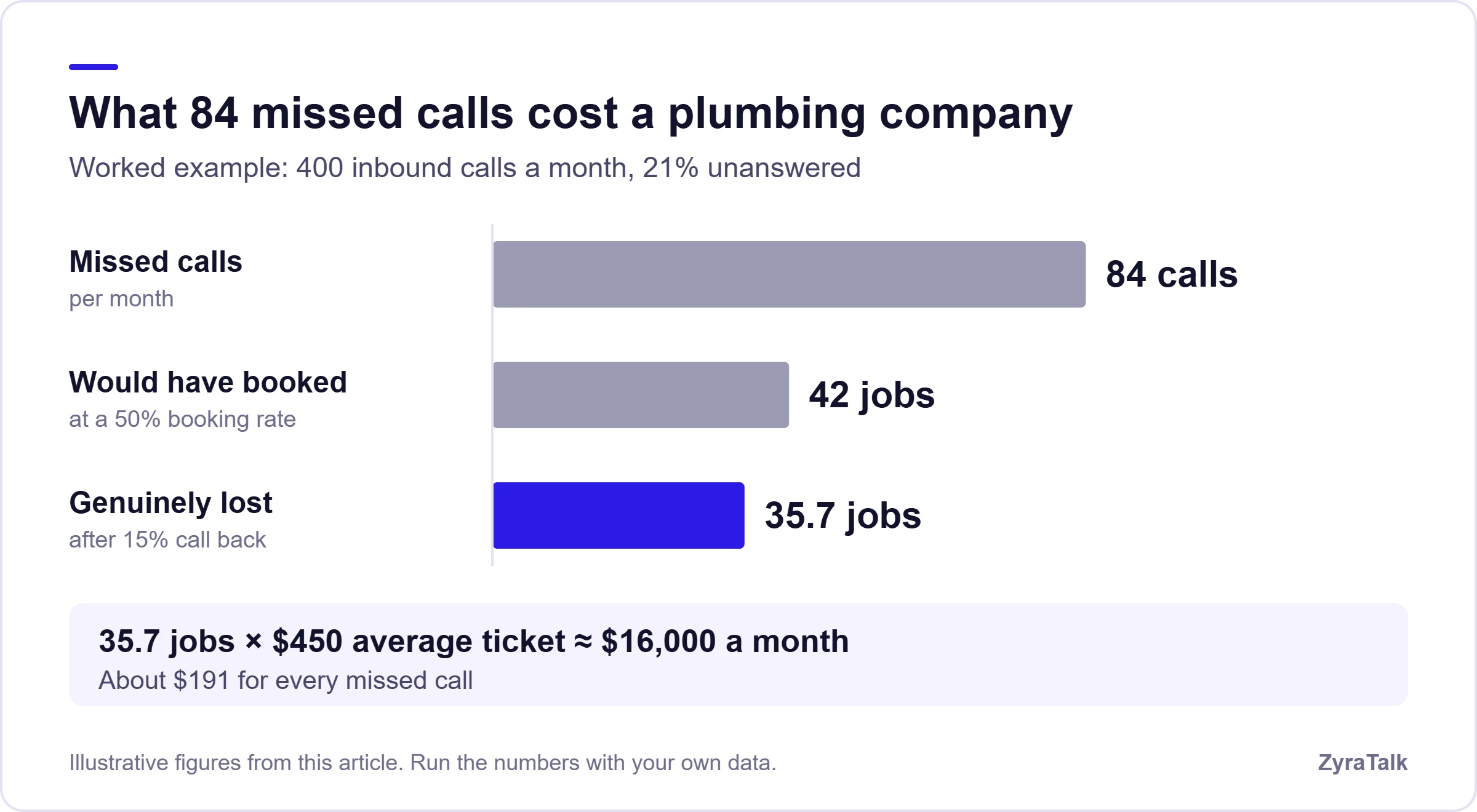
- Inbound calls per month: 400
- Unanswered: 84 (a 21% miss rate)
- Booking rate on answered calls: 50%
- Average ticket: $450
- Recovery rate: 15%
84 missed calls × 50% booking rate = 42 jobs that would likely have booked. Adjusting for the 15% who come back: 42 × 0.85 = 35.7 jobs genuinely lost. At $450 each, that is roughly $16,000 per month, or just under $193,000 a year.
The per-call figure: about $191 for every missed call.
What it looks like across trades
The same arithmetic produces very different numbers depending on your average ticket. The figures below are illustrative, so substitute your own.
| Trade | Avg. ticket | Booking rate | Cost per missed call | 100 missed calls = |
|---|---|---|---|---|
| Cleaning / recurring | $180 | 55% | ~$84 | ~$8,400 |
| Plumbing service | $450 | 50% | ~$191 | ~$19,100 |
| HVAC service + replacement mix | $1,200 | 45% | ~$459 | ~$45,900 |
| Roofing (insurance / retail mix) | $9,500 | 25% | ~$2,019 | ~$201,900 |
Cost of a missed call FAQs
How much does a missed call cost a business?
It depends entirely on your average ticket and booking rate. The formula is booking rate × average ticket × (1 − recovery rate). For a plumbing company with a $450 average ticket and a 50% booking rate, roughly $190 per missed call, and considerably more once repeat work and referrals are counted.
Do most people leave a voicemail if you don't answer?
No. Most callers hang up rather than leave a message, particularly when the problem is urgent and other contractors are one tap away in the search results. This means voicemail volume badly understates how many leads you actually missed.
How do I find out how many calls I'm missing?
Export thirty days from your phone carrier's call log, or check your call tracking software if you run tracking numbers. Count total inbound versus unanswered, then segment by hour and day of week to find where the misses cluster.
What percentage of missed calls call back?
There is no reliable published figure and it varies by urgency and trade. In the absence of your own data, 10–20% is a conservative planning assumption. Businesses with automated text-back typically recover more than those without.
Is it worth paying for an answering service?
Compare the monthly cost against your calculated monthly missed-call loss, not against zero. For most home service businesses with a meaningful miss rate the loss substantially exceeds the cost of coverage, but run your own numbers rather than taking that on faith.
Does a missed call cost more than the job value?
Usually yes, over time. A first-time customer typically generates repeat work, possibly a maintenance agreement, and referrals. The single-job figure is the floor, not the total.