
An AI receptionist is software that answers your business phone, holds a normal spoken conversation with the caller, figures out what they need, and takes action: booking the appointment, taking a message, or passing an emergency to a real person. Unlike an old phone menu, the caller just talks. Unlike voicemail, something actually happens.
What is an AI receptionist?
An AI receptionist is software that answers incoming phone calls and handles them like a good front-desk employee would. It picks up, greets the caller, listens to what they say in ordinary conversational speech, and then does something useful with it: schedules the appointment, answers a common question, takes down the details, or hands the call to a person when the situation calls for one.
The important part is the second sentence. Plenty of technology answers phones. What separates an AI receptionist from a voicemail box or a phone menu is that it can understand an unscripted sentence and act on it. A caller can say "my kitchen sink is backing up and there's water on the floor" and the system can recognize that as an urgent plumbing issue, ask the right follow-up questions, and get someone dispatched, without the caller ever pressing a number.
- An AI receptionist answers calls conversationally, so callers speak normally instead of navigating a menu.
- It differs from voicemail, which only records, and from an IVR phone tree, which only routes by keypad.
- It works around the clock, and can handle several calls at the same time.
- It fits businesses where calls are the main way work arrives and staff are frequently unavailable to answer, which describes most home service companies.
- It is not a full replacement for a person. Complex, emotional, or unusual calls still need a human, and a good setup routes them there.
How AI phone answering actually works
Strip out the jargon and there are four steps.
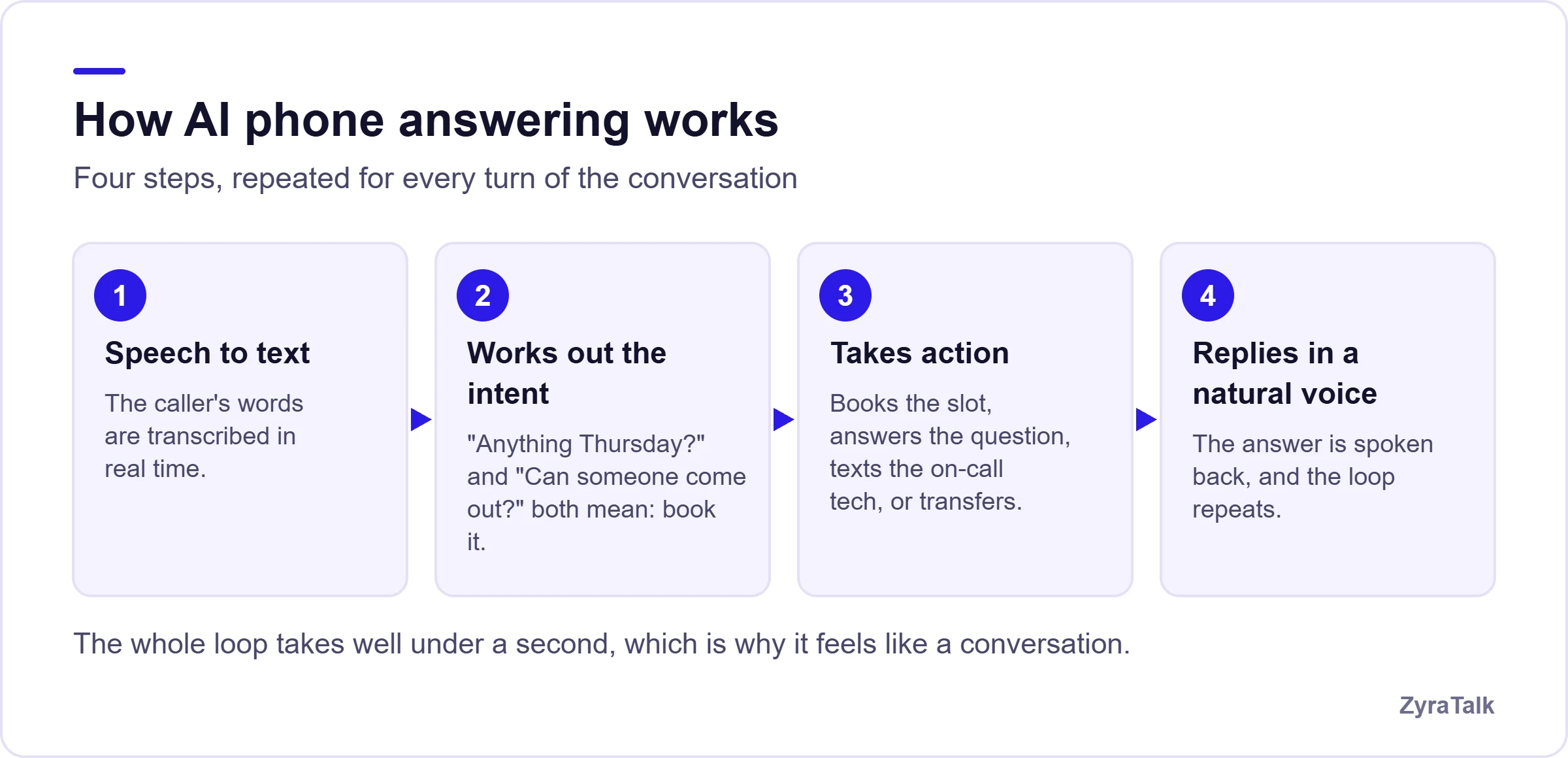
1. It converts speech into text
When the caller speaks, the system transcribes what they said in real time. This is the same underlying technology as the dictation feature on your phone, and it has become very accurate, though, as covered below, noisy job sites and heavy accents remain the hard cases.
2. It works out what the caller wants
This is the part vendors call natural language understanding, and it just means the software identifies the intent behind the words. "Do you have anything Thursday," "can someone come out this week," and "I need to get on the schedule" are three different sentences with one intent: book an appointment. Older phone systems could not do this, which is why they needed you to press 2.
3. It takes action
Having identified the intent, the system does something. Depending on how it is configured, that means checking your calendar and booking a slot, looking up an answer to a common question, writing the details into your field service software, sending your on-call tech a text, or transferring the call to a person.
4. It replies in a natural voice
The response is spoken back in a synthesized voice. Voice quality has improved substantially in the last two years. This is the single biggest reason AI receptionists became viable recently, and why an experience most people found irritating in 2019 is tolerable now.
The whole loop takes well under a second, which is what makes it feel like a conversation rather than a transaction with a machine.
Can AI answer phone calls for my business?
Almost certainly yes, technically. The more useful question is whether it is worth it, and that depends on the shape of your business.
It fits well when
- Phone calls are how work arrives. Home services, trades, clinics, legal, anywhere the customer's first move is to dial.
- Your staff cannot reliably answer. Crews in the field, one office manager, no dedicated front desk.
- Calls arrive outside business hours. Emergencies and evening inquiries otherwise hit voicemail.
- Volume spikes. Peak season produces several simultaneous calls that one person cannot take.
- The routine calls are genuinely routine. Booking, hours, service areas, pricing ranges, status checks.
It fits poorly when
- Call volume is very low. If you take four calls a week and answer them all, there is nothing to fix.
- Every call is complex and consultative. If no two calls are alike and each needs deep judgment, the routine-handling benefit shrinks.
- Your customers strongly prefer a specific person. Some relationship-driven businesses genuinely trade on the owner picking up.
Will customers know they're talking to AI?
This is the question almost every owner asks first, and most vendor pages avoid it. The honest answer has three parts.
Many callers will not immediately notice. Current voice quality and response speed are good enough that a short, routine call, such as booking a service window or asking about hours, often passes without the caller giving it a thought.
Some will notice, and that is fine. Callers who ask an unusual question, interrupt, or go off-script will generally work it out. In practice this matters far less than owners fear. What frustrates people is not talking to software; it is talking to software that cannot help them. A system that books the appointment in ninety seconds tends to be received well, and compares favorably to a voicemail box.
What the disclosure rules currently say
In most US states there is still no general law requiring a business phone assistant to announce that it is AI, and the handful of states that do regulate it use different triggers. As of mid-2026, the picture for a customer-service voice agent looks roughly like this:
| State | Law | What triggers a disclosure duty |
|---|---|---|
| Maine | Chatbot Disclosure Act (LD 1727), in force since September 2025 | Notice required whenever a reasonable consumer could be misled into thinking they are talking to a person. Enforced under the state's Unfair Trade Practices Act. |
| Utah | AI Policy Act (SB 149, as amended), in force since May 2024 | You must answer truthfully if the caller asks whether they are talking to AI. Regulated professions must disclose proactively at the start. |
| California | SB 243, effective January 2026 | Targets companion chatbots and expressly excludes customer service. A separate bill to extend disclosure to customer service was still moving through the legislature in spring 2026. |
| Colorado | Colorado AI Act (SB 24-205) | Disclosure tied to high-risk systems making consequential decisions. Home service booking is unlikely to qualify, but the compliance date has moved more than once. |
Separately, the FTC Act applies nationwide, and the Commission's long-standing position is that concealing an automated interaction can amount to a deceptive practice. That federal exposure exists regardless of which state you operate in.
This area moved several times in the last twelve months and the summary above describes the position as reported in mid-2026. Confirm current requirements in your own operating states with counsel before relying on any of it.
The practical recommendation, independent of the legal minimum: disclose it, briefly and without apology, in the greeting. Something like "Hi, this is the automated assistant for [Company], I can get you booked in." It sets accurate expectations, it stays defensible as the rules evolve, and it removes the awkward moment where a caller realizes mid-sentence.
What an AI receptionist cannot do
Every vendor page in the top results is selling something, which makes the limitations hard to find. The real ones:
- Handle genuinely unusual situations. Anything outside the configured scope needs escalation. This is a configuration question rather than a failure, but it means the escalation path has to be set up properly, and tested.
- Read emotional context reliably. A distressed customer, a complaint, a dispute over an invoice, these want a person, quickly. Good setups detect frustration and transfer; none do it perfectly.
- Cope perfectly with bad audio. Job-site noise, poor cell reception, and strong accents all degrade accuracy. Any system will occasionally mishear a street name. Confirmation steps for addresses and phone numbers matter more than vendors admit.
- Exercise judgment on pricing or scope. It can quote a configured range. It cannot decide to discount a job because the customer sounds like a good referral source.
- Replace your best CSR. An experienced office manager who knows the regulars, hears that a caller is stressed, and upsells naturally is doing something the software is not attempting.
The realistic framing is that an AI receptionist handles the routine volume and the hours nobody covers, and routes everything else to the people who should have it. Businesses that deploy it as a total replacement for human judgment tend to be disappointed. Businesses that deploy it against voicemail tend not to be.
How it compares to the alternatives
| Voicemail | IVR phone menu | Live answering service | AI receptionist | |
|---|---|---|---|---|
| Caller speaks naturally | No | No, keypad only | Yes | Yes |
| Books appointments | No | No | Sometimes | Yes |
| Available 24/7 | Records only | Routes only | Usually, at a cost | Yes |
| Handles simultaneous calls | Not applicable | Yes | Depends on staffing | Yes |
| Knows your business specifics | No | No | Partially, from a script | Yes, once configured |
| Handles complex or emotional calls | No | No | Yes | Escalates to a human |
| Typical cost | Free | Low | Per-minute or per-call | Monthly plan |
What it costs
Pricing generally follows call volume, either a monthly plan sized to expected minutes or per-minute billing, often with a one-time setup fee to configure routing rules and train the system on your services. The comparison that matters is not against zero; it is against the alternatives. A live answering service billed per minute gets expensive at volume, an additional office hire is a salary, and voicemail is free but converts poorly. Run your own numbers using your call volume and average job value.
How ZyraTalk fits
ZyraTalk is an AI receptionist built specifically for home service businesses. It answers every call 24/7 including simultaneous calls during seasonal surges, triages urgency so a no-heat call in January goes straight to your on-call tech, books jobs directly into field service platforms like ServiceTitan, Housecall Pro, and Service Fusion, and logs every call with a full transcript. If a call is ever missed, it follows up by text within seconds.
An AI receptionist is not a futuristic idea any more. It is a practical answer to a specific problem, which is that the phone rings when everyone is busy. Understanding what it does well, and what it hands off, is most of what you need to decide whether it belongs in your business.
Hear it handle a real call
ZyraTalk answers, qualifies and books for plumbing, HVAC, electrical, cleaning and painting businesses. Bring your hardest test call to the demo, including the emergency one.
Book a demo- Books into ServiceTitan and Housecall Pro
- Emergencies routed to your on-call tech
- Full transcript on every call
AI receptionist FAQs
What is an AI receptionist?
Software that answers your business calls, understands what the caller says in ordinary speech, and takes action: booking appointments, answering routine questions, capturing details, or transferring urgent calls to a person. It works around the clock and can handle multiple calls at once.
How is an AI receptionist different from an IVR?
An IVR is a keypad menu: press 1 for sales, press 2 for service. It only routes. An AI receptionist listens to natural speech, works out what the caller actually needs, and can complete the task rather than passing it along.
Can an AI receptionist book appointments?
Yes. That is the primary use case for most home service businesses. It checks availability, confirms a time with the caller, and writes the booking into your scheduling system during the call.
Do I have to tell callers it's AI?
In most US states there is no general requirement for a customer-service phone assistant, but Maine requires notice where a caller could reasonably be misled, and Utah requires a truthful answer if the caller asks. The FTC also treats concealed automation as potentially deceptive. Rules are changing quickly, so confirm your own states with counsel. Brief disclosure in the greeting is the practical default regardless.
What happens if the AI can't help the caller?
It should escalate to a human, by transferring the call, texting an on-call tech, or taking a detailed message for callback. How well this works depends entirely on how the escalation rules are configured, so test them before going live.
Is an AI receptionist cheaper than hiring someone?
Generally yes, on a straight cost comparison against a full-time front-desk salary, and it also covers nights and weekends that a single hire cannot. The more useful comparison for most home service businesses is against voicemail, since measured against calls currently ringing out unanswered the arithmetic is usually not close.