Missed call text-back automatically sends an SMS to anyone whose call you did not answer, so the caller gets an immediate acknowledgment and a way to continue by text. It is cheap, easy to set up, and it genuinely recovers leads that would otherwise vanish. It is also a recovery tool for a failure that already happened, and there are four situations where it does not help at all.
What is missed call text-back?
Missed call text-back is an automated SMS that fires when an inbound call to your business goes unanswered. The caller hangs up, or gets sent to voicemail, and within seconds receives a text from your business number acknowledging the missed call and inviting them to reply.
The logic is simple. Most people will not leave a voicemail, and many will not call back a second time. But a large share will reply to a text, because replying is easier than redialing. Text-back converts a dead end into an open thread.
- Text-back recovers a meaningful share of missed calls at very low cost, and is one of the easiest wins available to a small home service business.
- It is a recovery mechanism, not a coverage mechanism. The call was still missed.
- US and Canadian businesses must complete A2P 10DLC registration or messages will be filtered without warning.
- It is the wrong tool for emergency calls, for callers who do not text, and for anything requiring a real conversation to book.
- It works best layered underneath live answering, not as a replacement for it.
How missed call text-back works
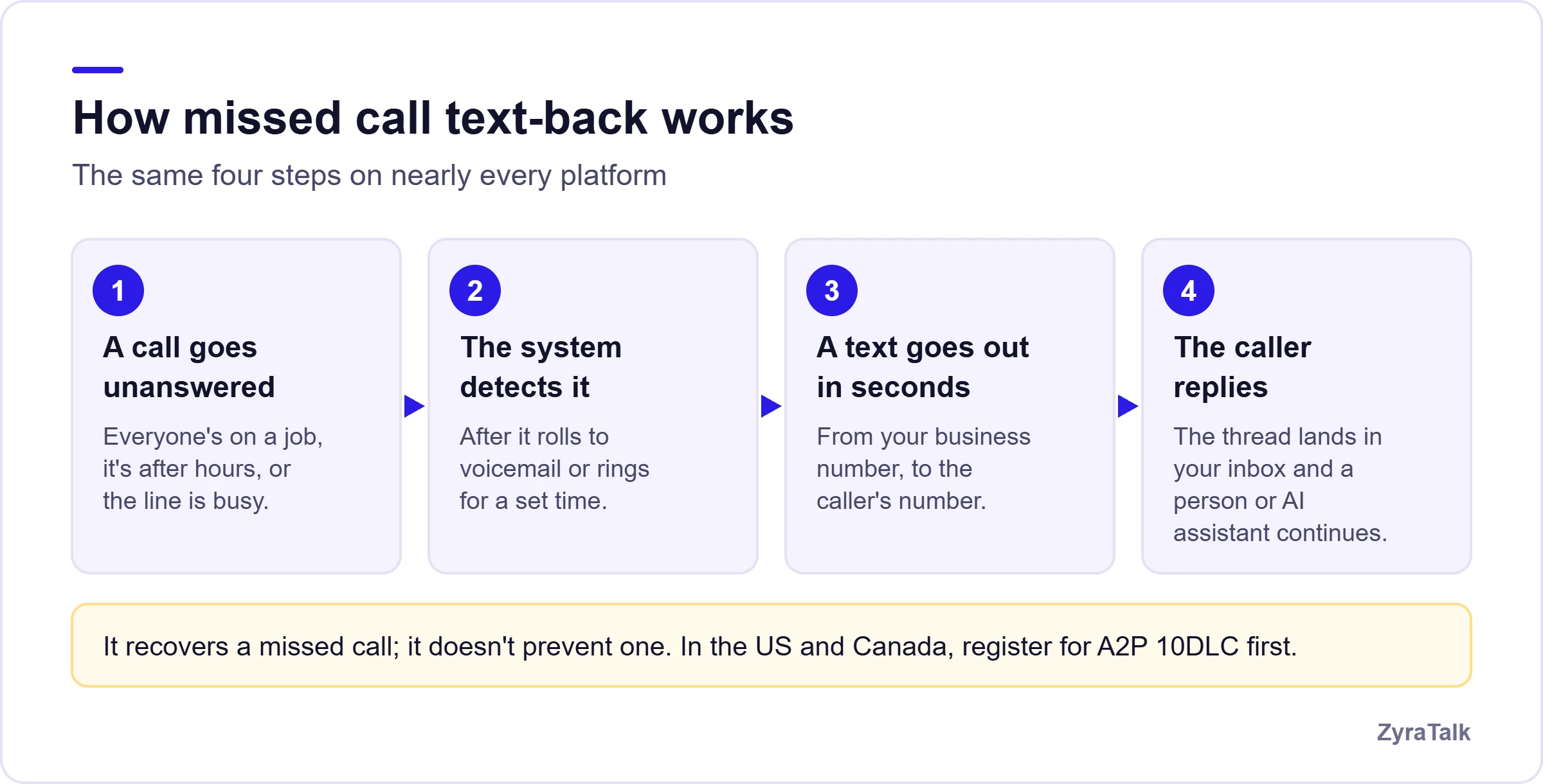
The mechanism is the same across nearly every platform that offers it:
1. A call comes in to your business number and is not answered, because everyone is on a job, because it is after hours, or because the line was busy.
2. The system detects the unanswered call, usually after it rolls to voicemail or after a set ring duration.
3. An SMS is sent automatically from your business number to the caller's number, typically within a few seconds.
4. The caller replies. The thread lands in whatever inbox your team monitors, and a human, or an AI assistant, continues from there.
Setup on most platforms takes under an hour: connect the business number, write the message, set business hours, and turn it on. The technical lift is genuinely small, which is a large part of the appeal.
What it costs
The feature itself is often bundled free with a phone system or CRM. The real costs are the per-message carrier fees, which are fractions of a cent each but accumulate at volume, and the registration process below. For most small home service businesses the running cost is negligible relative to a single recovered job.
The registration requirement almost every guide skips
In the United States and Canada, businesses sending application-to-person SMS from a standard 10-digit number must register their brand and campaign through A2P 10DLC. If you skip it, carriers filter your messages. They do not bounce visibly. They simply stop arriving, and your dashboard may still report them as sent.
Registration is handled through your SMS provider, usually takes a few days, and requires basic business details such as legal name, EIN and a use case description. Budget for it before you promise the feature to anyone.
This matters more than it sounds. A text-back system that is silently filtered is worse than no system at all, because you will believe missed calls are being recovered while the callers hear nothing.
Where missed call text-back falls short
Every vendor page describing this feature is selling it, so the limitations are hard to find. There are four that matter.
1. It is the wrong response to an emergency
A homeowner standing in an inch of water does not want a text message. Neither does someone with no heat in January or a burning smell from a panel. Urgent callers need a person, immediately, and an automated "sorry we missed you" reads as an insult in exactly the moments when the job is most valuable and the customer is most motivated. If your trade skews toward emergency work, text-back covers your least valuable calls well and your most valuable calls badly.
2. The call was still missed
This is the framing no vendor page will offer. Text-back does not stop you missing calls; it softens the consequence. The caller still experienced your business failing to pick up, and they are frequently already dialing the next contractor while your text arrives. Recovery rates are real but partial. You are competing for a lead you had and lost.
3. Not everyone texts
Demographics vary by trade and service area, and a segment of home service customers, skewing older, will not engage with an automated text from a business they have never dealt with. Some will read it as spam. For those callers the missed call remains simply missed.
4. Naive implementations misfire
If the caller immediately redials and reaches you, or texts you first, a poorly configured system still sends the automated apology. The customer is now talking to a human and receiving a message saying you were unavailable. It reads as broken. Good implementations suppress the message when contact has already been established; many default configurations do not, and users of major platforms have filed feature requests asking for exactly this.
Consent and compliance
Texting someone who just called your business is generally a defensible use. They initiated contact, and the message is a direct response to their inquiry. That said, business texting sits under the TCPA in the US, and the safe practices are worth following: identify your business clearly in the message, keep the content responsive to their inquiry rather than promotional, honor opt-outs immediately and automatically, and do not roll these numbers into a marketing list without separate consent. This article is general information rather than legal advice, so have counsel review your specific message templates and opt-out handling before launch.
Message templates for home service businesses
Short, identified and specific converts better than clever. Four to adapt:
General business hours
"Hi, this is [Business Name]. Sorry we missed your call, we're with a customer. Reply here and we'll get you sorted. What's going on at your place?"
After hours
"[Business Name] here, thanks for calling. Our office is closed but we're monitoring texts. If this is an emergency, reply URGENT and we'll get someone on it. Otherwise we'll reach out first thing."
Peak season or high volume
"Thanks for calling [Business Name]. We're getting a lot of calls today and didn't want to leave you waiting. Reply with your address and the issue and we'll get you on the schedule."
Emergency-aware
"Sorry we missed you, this is [Business Name]. If you have an active leak, no heat, or anything urgent, call [emergency line] and it will reach someone directly. For anything else, just reply here."
That last template is the one most businesses skip and the one that matters most. Giving urgent callers a second path is the cheapest fix for the biggest limitation.
Text-back vs. answering the call
| Voicemail only | Missed call text-back | Live / AI answering | |
|---|---|---|---|
| Caller experience | Asked to try again later | Acknowledged in seconds | Talks to someone now |
| Handles emergencies | No | Poorly | Yes |
| Can book the job | No | Only after a reply thread | On the call |
| Works after hours | Records only | Yes | Yes |
| Setup effort | None | Low, plus 10DLC registration | Moderate |
| Cost | Effectively free | Low | Higher |
| What it actually is | No response | Damage control | Coverage |
These are not mutually exclusive, and the strongest setup uses two of them together: answer calls live, and keep text-back running underneath as a safety net for the calls that still slip through. Text-back as your only line of defense means every lead has already had a bad experience before you begin recovering it.
How to know if it is working
Three numbers tell you most of what you need:
- Reply rate: what share of text-backs get a response. If this is very low, check your 10DLC registration status before you rewrite the message.
- Recovery rate: what share of texted callers become booked jobs. This is the number that justifies the tool.
- Missed call volume itself: if this is climbing, text-back is treating a symptom. The underlying coverage problem is getting worse.
How ZyraTalk approaches this
ZyraTalk treats text-back as the backstop rather than the plan. Calls are answered live by an AI receptionist that qualifies the caller, books the job into your field service software, and routes genuine emergencies to your on-call tech. If a call is ever missed anyway, an automatic text follows within seconds so the conversation stays open. The distinction matters: the goal is for text-back to fire rarely, because the call was answered in the first place.
Missed call text-back is a good tool with a narrow honest description. It recovers some of the leads you already lost, cheaply. That is worth having. It is not the same as not losing them.
Recover fewer calls by missing fewer calls
ZyraTalk answers live for plumbing, HVAC, electrical, cleaning and painting businesses, then falls back to an automatic text only if a call somehow slips through.
Book a demo- Live answering, not an apology text
- Emergencies routed to a human
- Text-back as the safety net
Missed call text-back FAQs
Does missed call text-back actually work?
It recovers a real share of missed calls, particularly for non-urgent inquiries and after-hours calls from customers comfortable with texting. It works considerably less well for emergencies and for callers who do not text. Treat published recovery statistics from vendors with appropriate skepticism.
Do I need 10DLC registration for missed call text-back?
In the US and Canada, yes, if you are sending from a standard 10-digit business number. Without it, carriers filter your messages and you will likely not be told. Your SMS provider handles the submission; expect it to take a few days.
Is texting a missed caller legal?
Responding by text to someone who just called your business is generally considered a responsive communication rather than unsolicited marketing. Identify your business, keep the message responsive, honor opt-outs, and get counsel to review your templates, particularly before adding these numbers to any marketing list.
What should the message say?
Identify the business by name, apologize briefly, invite a reply, and give urgent callers an alternative path. Skip the marketing copy, because this message has one job.
Can it book appointments on its own?
Basic text-back cannot; it starts a thread that a human then handles. Some platforms layer conversational AI on top so the text thread can qualify and schedule. If booking matters to you, confirm which one you are buying.
Is text-back a replacement for an answering service?
No. Text-back responds after a call is missed; an answering service prevents the miss. They solve adjacent problems and work well together, but substituting one for the other means accepting that every caller hits voicemail first.