
Qualifying an inbound home service call is not the same as qualifying a B2B sales lead. The homeowner already has a problem and already intends to hire someone, so your job is to find out what you need in order to serve them, not to work out whether they are worth your time. Ask in the wrong order and you will lose jobs you had already won.
Why BANT will lose you jobs
Search this topic and you will find BANT and MEDDIC everywhere: frameworks built for business-to-business software sales, where a rep on a scheduled discovery call needs to establish whether a company has budget, authority, need and timeline before investing weeks in a deal.
Now picture applying that literally to a woman calling on a Saturday morning because her water heater has failed:
- "What's your budget for this project?" She does not have one. Her water heater broke ninety seconds ago.
- "Are you the decision maker?" It is her house.
- "What's your timeline?" There is water on the floor.
- "What other solutions are you evaluating?" She is going to hang up and call the next plumber.
The frameworks are not wrong; they are built for a different situation. In B2B, qualification exists to protect the seller's time from prospects who will never buy. On an inbound home service call, the caller has already self-qualified by dialing. They have a problem, they intend to pay someone to fix it, and they are choosing between you and whoever else picks up.
So the purpose of your questions changes completely. You are not deciding whether to pursue them. You are gathering what you need to serve them, and demonstrating competence while you do it.
- Inbound home service callers arrive pre-qualified. They have a problem and intent to hire.
- Your questions exist to scope and schedule the job, not to filter the caller.
- Sequence matters more than content: acknowledge the problem, diagnose, then collect details.
- Budget and authority questions asked early read as intrusive and lose jobs.
- The price question deserves a real answer. A range beats a refusal every time.
The right sequence
Most CSR performance gaps come down to order rather than content. The sequence that works:
- Acknowledge the problem. One sentence, before anything else. "Water on the floor, okay, let's get someone out to you." This costs three seconds and changes the entire tone of the call.
- Diagnose enough to scope it. Two or three questions that establish what is actually happening and how urgent it is.
- Confirm you can serve them. Location and service type. Do this before collecting full details so you are not taking an address you cannot serve.
- Book it. Offer two specific times.
- Then collect the admin details. Full name, address, contact number, access notes.
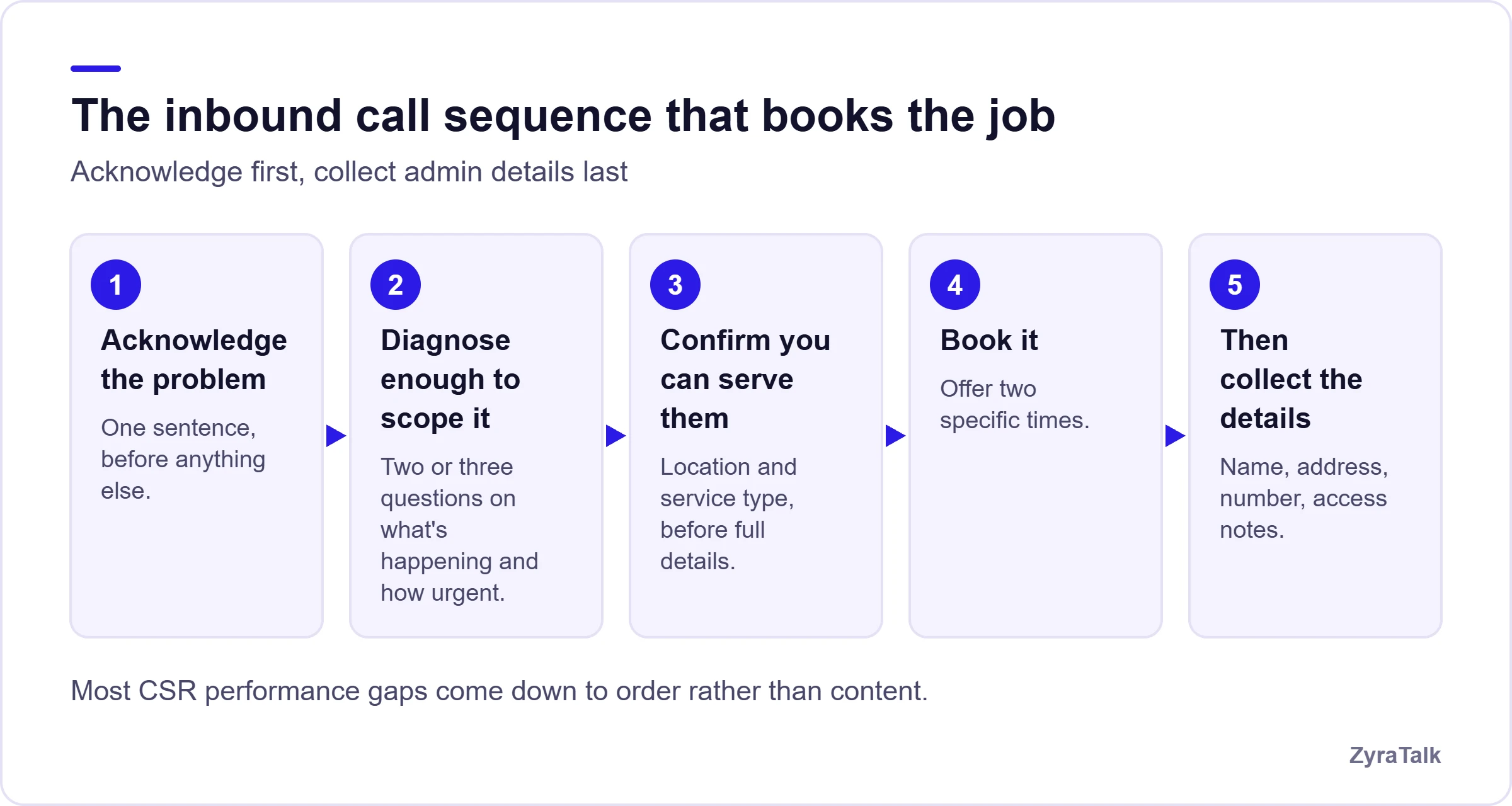
The instinct in a busy office is to reverse this and start with name and number so nothing is lost if the call drops. It is understandable and it costs bookings, because the caller experiences a form being filled in rather than a problem being addressed. Get the acknowledgment in first.
The question set
Copy these and adapt to your trade. They are grouped by call type because an emergency call and an estimate request need different handling.
Emergency or urgent calls
Goal: establish severity, protect the customer, dispatch.
- "Tell me what's happening right now." (Open, and it gets you the whole picture faster than a checklist.)
- "Is water actively running, or has it stopped?" (Or the trade equivalent: is the smell still there, is the unit still running.)
- "Do you know where your shut-off valve is?" (Genuinely helpful, and it establishes competence immediately.)
- "Is anyone in the house at risk right now?"
- "What's the address? I'll get someone routed to you."
- "Is there anything the tech needs to know to get in, like a gate code, a dog, or parking?"
Standard service calls
Goal: scope the work, book a window.
- "What's going on with it?"
- "How long has it been doing that?"
- "Has anyone looked at it already?" (Tells you if you are the second opinion, which changes the visit.)
- "Roughly how old is the unit, if you know?" (Scopes parts and likelihood of replacement.)
- "Is this the first time, or has it happened before?"
- "What's the address so I can check who's covering your area?"
- "I've got Thursday morning or Friday afternoon. Which suits you better?"
Estimate and replacement inquiries
Goal: understand scope, set expectations, get the visit booked.
- "What's prompting you to look at replacing it now?" (The single most useful question on this type of call. The answer tells you urgency, budget sensitivity, and whether they are shopping.)
- "Is the current system still running, or has it failed?"
- "How long have you been in the property?" (Proxy for how long they will hold the investment.)
- "Have you had other quotes yet?" (Neutral and useful. Note this is different from asking who else they're evaluating in a pressuring way.)
- "Is there a date you're working toward?"
- "Would mornings or afternoons work better for someone to come take a look?"
Repeat customers
- "Good to hear from you. Is this for the same property?"
- "Is this related to the work we did last time, or something new?" (Catches callbacks and warranty work before they become a billing dispute.)
Questions that cost you the job
This is the section the B2B articles have no reason to write, and it matters more than the question list above.
"What's your budget?"
The most damaging question you can ask a homeowner early in a call. It implies you are sizing them up, it is unanswerable for an unexpected repair, and it makes a stressed caller feel judged. If you need to understand budget sensitivity, get it indirectly. "Are you looking to repair this, or is replacement on the table?" gets you the same information without the interrogation.
"Are you the homeowner?" (asked first)
You do need to know this before major work. Asked as the opening question it is insulting. Fold it in naturally later: "and you're the owner at that address, or are you managing it for someone?"
"Who else are you calling?"
Directly imported from B2B qualification, and it reads as territorial. The caller now feels awkward and is reminded that they were planning to call someone else. "Have you had other quotes yet?" gets the same intelligence and sounds like normal conversation.
A rapid-fire data collection opener
"Name? Phone number? Address? Email? What's the issue?" This is efficient for your CRM and terrible for conversion. It reads as processing rather than helping. Acknowledge first.
"Can I put you on a brief hold?" (before doing anything useful)
Not technically a qualifying question, but it belongs on this list because of how often it ends calls. With competitors one tap away, hold is where bookings go to die. If you must, keep it short and explain why.
Handling the price question
Almost every caller asks some version of "what's this going to cost?" and the way it is handled decides a meaningful share of bookings.
What loses the job: "We can't give any pricing until we see it." Often true, and it sounds evasive. The caller's next move is to ask someone who will answer.
What works: a range, an honest reason for the range, and a clear next step.
"Most jobs like this land somewhere between $300 and $600. It depends on whether it's the valve or the whole unit, and the tech will confirm before doing any work. There's a $79 diagnostic that comes off the repair if you go ahead. Can I get someone out Thursday?"
Three things happen here: the caller gets a real answer, the variability is explained rather than hidden, and the call moves toward booking instead of ending on the price question.
This requires the person answering to have an authorized range for common jobs. If they do not, that is a management gap rather than a CSR performance issue, and it is one of the fastest fixes available for a low booking rate.
How ZyraTalk handles qualification
ZyraTalk asks these questions on every call, including the ones that arrive at 9 p.m. or while your office is already on the line. It follows the same sequence of acknowledge, diagnose, confirm service area, book. It distinguishes genuine emergencies from routine requests and routes urgent calls straight to your on-call tech. The details land in your field service software with a full transcript, so the tech arrives knowing what the caller said rather than reading a two-line message.
The core insight is simple enough to hold onto: a homeowner who calls you has already decided to hire someone. Your questions should feel like the beginning of the work, not an application process.
Every call qualified the same way, every time
Your best CSR asks the right questions in the right order. ZyraTalk does it on every plumbing, HVAC, electrical, cleaning and painting call, including nights, weekends and the ones that come in while the office is already on the line.
Book a demo- Acknowledges before it collects
- Full transcript into your software
- Routes emergencies to your on-call tech
Lead qualifying questions FAQs
What are good qualifying questions for a service business?
Start by acknowledging the problem, then ask what is happening, how long it has been happening, whether anyone has looked at it already, and where the property is. Collect names and contact details after the caller feels heard, not before.
Should I use BANT for inbound calls?
No. BANT is built for B2B outbound sales where qualification protects the seller's time. An inbound home service caller has already self-qualified by calling with a problem, and the budget and authority questions read as intrusive.
How many questions should I ask before booking?
Enough to scope the job and confirm you can serve the area, usually three to five. More than that starts to feel like an interview, and every additional question is a chance for the caller to disengage.
What if the caller asks for a price?
Give a range with an honest explanation of what drives it, then move to booking. A refusal to quote anything is the answer most likely to send them to a competitor who will.
How do I qualify without sounding like an interrogation?
Acknowledge the problem in your first sentence, ask open questions rather than a checklist, and explain why you need anything that might sound intrusive. Sequence does most of the work.
Should I disqualify callers who aren't ready to book?
Rarely worth it on inbound. Someone gathering quotes today may book next week, and the cost of a courteous conversation is low. Capture their details and follow up rather than ending the call early.