
Cost per lead is what you pay for one inquiry. In home services it typically runs from tens of dollars for referral and organic traffic to several hundred for competitive paid channels in high-ticket trades. But CPL on its own is a misleading number to manage — what matters is cost per booked job, and that depends as much on whether you answer the phone as on what you paid for the lead.
What is cost per lead?
Cost per lead is your marketing spend divided by the number of leads it produced.
A "lead" needs defining before the number means anything. For most home service businesses it should mean a genuine inquiry — a real person asking about real work. If your count includes wrong numbers, robocalls, and vendor solicitations, your CPL will look better than it is. Filter first, then calculate.
- Published CPL benchmarks disagree with each other by several times over for the same trade, so treat any single figure as directional at best.
- Nearly all available CPL data comes from agencies and lead vendors with a commercial interest in the framing.
- CPL is a purchasing metric. Cost per booked job is the operating metric, and the gap between them is your answer and booking rate.
- On shared-lead marketplaces, your effective CPL is a multiple of the sticker price, because the lead is sold to several contractors.
- Improving your booking rate lowers cost per booked job without renegotiating a single lead price.
Benchmark ranges by channel
Treat these as orientation rather than targets. Ranges are wide because market competitiveness, trade, and season all move the number substantially.
| Channel | Typical CPL range | Intent | Notes |
| Referrals | Near zero to ~$50 | Highest | Usually just an incentive cost. Highest close rate of any channel. |
| Organic search / SEO | Effectively $0 marginal after investment | High | Upfront cost is real; payback typically 6–18 months. |
| Local Services Ads | ~$25–$100+ | Very high | Charges per lead, not per click. Disputable bad leads — most contractors under-use this. |
| Google Ads (search) | ~$50–$300+ | High | Rises steeply in peak season and competitive metros. |
| Shared-lead marketplaces | ~$15–$100 sticker | Mixed | Sold to multiple contractors — see effective CPL below. |
| Paid social | ~$30–$150 | Lower | Better for remarketing and awareness than direct booking. |
| Direct mail | Highly variable | Low–mixed | Hard to attribute; useful in dense, established service areas. |
These ranges are examples
Why published CPL benchmarks deserve scepticism
Nearly every source of home services CPL data has a commercial position:
- Marketing agencies publish CPL figures for channels they manage. Favorable numbers support their retainer.
- Pay-per-lead vendors publish CPL by industry. Their figures are their own price list, framed as market research.
- Software companies publish benchmarks drawn from their own customer base, which is not a random sample of the industry.
None of that makes the numbers useless — it makes them a starting hypothesis rather than a standard. Your own CPL, calculated from your own spend and your own filtered lead count, is the only figure worth managing against.
CPL by trade
Ticket size drives what a lead is worth, and therefore what the market will bear:
- Roofing — among the highest CPL in home services. Large tickets, insurance work, and aggressive storm-season competition push paid leads well into the hundreds.
- HVAC — high, and sharply seasonal. Replacement-intent leads command a premium over service-call leads.
- Plumbing — moderate, with emergency leads priced higher than routine work.
- Electrical — moderate, similar dynamics to plumbing.
- Cleaning and recurring services — lowest CPL, but also the lowest ticket, so the ratio can be tighter than the raw number suggests.
- Pest control — moderate, and unusually attractive because recurring contracts extend lifetime value well past the first job.
The pattern: high CPL is not automatically bad. A $400 roofing lead against a $9,500 average ticket is a better ratio than a $40 cleaning lead against a $180 ticket. Judge CPL against ticket size, never in isolation.
The number that actually matters: cost per booked job
Here is the gap in every ranking article on this topic. CPL measures what you paid to make the phone ring. It says nothing about whether anyone picked it up.
From CPL to cost per booked job
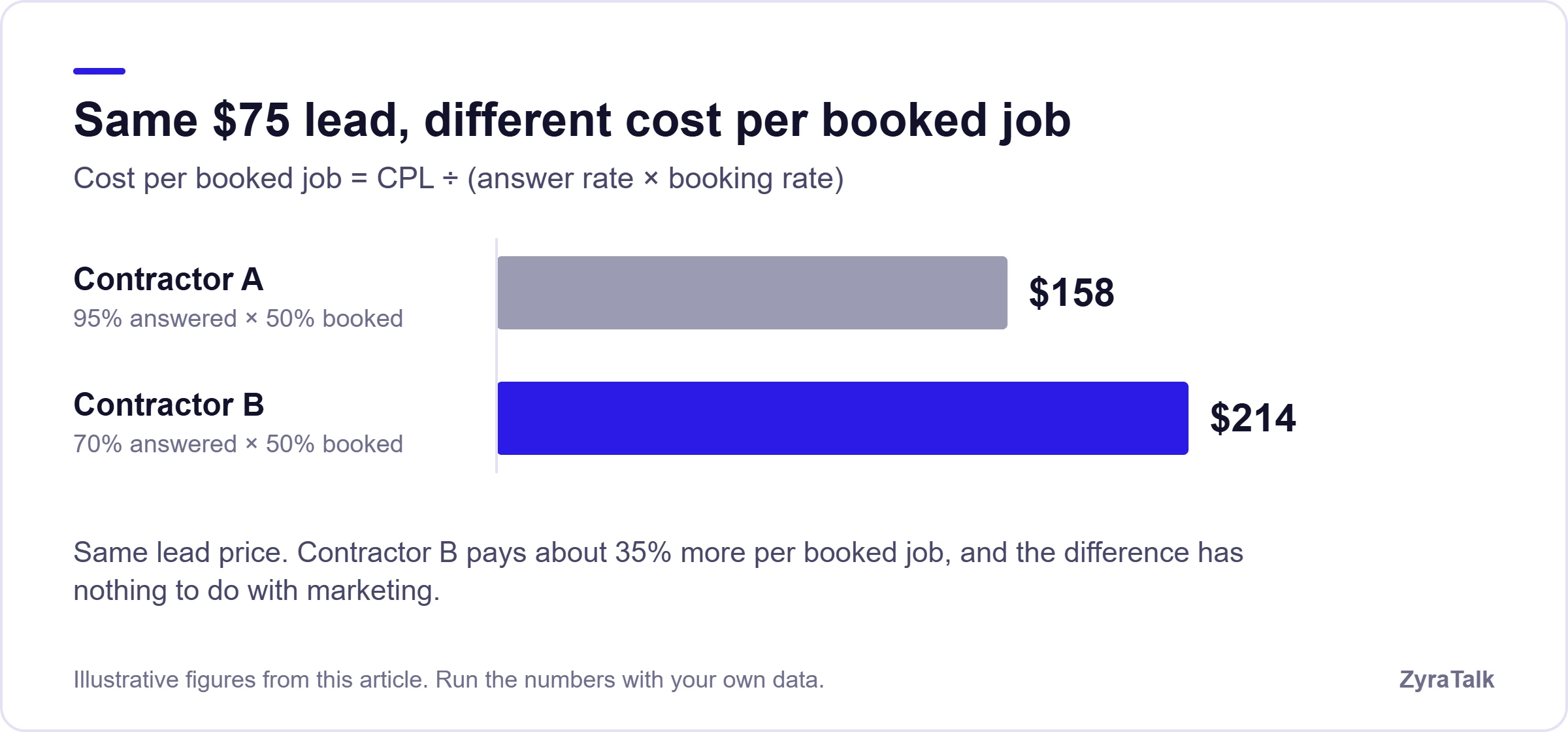
Cost per booked job = CPL ÷ (answer rate × booking rate)
Two contractors buying identical $75 leads:
Contractor A answers 95% of calls and books 50% of those. 0.95 × 0.50 = 0.475. Cost per booked job: $75 ÷ 0.475 = $158.
Contractor B answers 70% and books 50%. 0.70 × 0.50 = 0.35. Cost per booked job: $75 ÷ 0.35 = $214.
Same lead price. Contractor B pays 35% more per job — and the difference has nothing to do with marketing.
This is why optimizing CPL in isolation is a trap. A contractor can spend months negotiating lead prices down 10% while a 25-point answer-rate gap costs them substantially more than that. The cheapest available improvement in cost per booked job usually is not a cheaper lead — it is converting more of the leads already being purchased.
Shared-lead marketplaces and effective CPL
Marketplaces like Angi, Thumbtack, and HomeAdvisor sell the same inquiry to several contractors. If a lead costs $50 and is sold to four companies, the sticker price is $50 but the honest cost for the contractor who eventually wins the job is closer to $200 — because on average you buy four before landing one.
Two consequences worth internalizing:
- Your effective CPL is the sticker price divided by your win rate, not the sticker price.
- Response speed is the entire game. On a lead sold to four contractors, the one who calls back first wins a large share. This is the channel where speed to lead most directly converts into CPL — the fast contractor and the slow contractor pay the same sticker and get very different effective costs.
If you buy marketplace leads and cannot respond within minutes — including evenings and weekends — you are subsidizing whichever competitor can.
Seasonality
CPL is not a flat annual figure. Paid channel costs rise when everyone bids into the same demand spike: the first heat wave for HVAC, storm season for roofing, spring for landscaping. Conversion rates usually rise at the same time, and often faster, which means peak-season CPL can be higher while peak-season cost per booked job is lower.
Calculate CPL monthly and compare each month against the same month last year, not against the month before. Comparing July to October for an HVAC company produces a conclusion about the calendar, not about your marketing.
How to use CPL properly
- Define a lead and filter out junk before counting.
- Calculate per channel, monthly. Blended CPL is a reporting number.
- Convert to cost per booked job using your answer rate and booking rate. This is the figure to manage.
- Compare against average ticket, not against other trades' CPL.
- Fix the conversion side before renegotiating the purchase side. It is almost always the larger and cheaper lever.
Where ZyraTalk fits
ZyraTalk does not change what you pay per lead. It changes what share of those leads become jobs — by answering calls that currently go unanswered after hours, during peak surges, and when the office is already on the line. Because cost per booked job is CPL divided by your answer and booking rates, lifting the answer rate reduces effective cost across every channel simultaneously. On shared-lead marketplaces, where whoever responds first wins the lead everyone paid for, the effect is more pronounced.
Cost per lead is worth knowing and a poor thing to optimize alone. The contractors with the best marketing economics in this industry are rarely the ones who found the cheapest leads — they are the ones who answer.
Stop paying for leads that ring out
ZyraTalk answers every call for plumbing, HVAC, electrical, roofing, cleaning and painting businesses, then books the job into your field service software. No extra ad spend required.
Book a demo- Lowers cost per booked job on every channel
- First to respond on marketplace leads
- Nights, weekends and peak season
Cost per lead FAQs
What is a good cost per lead for home services?
There is no single answer — it depends on your trade, market, channel, and average ticket. A $300 roofing lead can be excellent while a $60 cleaning lead is marginal. Judge CPL against ticket size and against your own cost per booked job rather than against a published figure.
How do you calculate cost per lead?
Divide total spend on a channel by the number of genuine leads it produced in the same period. Filter out wrong numbers and solicitations first, or the figure will flatter you.
What's the difference between cost per lead and cost per acquisition?
Cost per lead is what you pay for an inquiry. Cost per acquisition (or CAC) is what you pay for a customer. The gap between them is your answer rate and booking rate.
Why is my cost per lead so high on Angi or Thumbtack?
Because the same lead is sold to several contractors, so your effective cost is the sticker price divided by your win rate. Response speed is the main determinant of who wins — contractors who reply within minutes convert a much larger share of the leads everyone paid for.
Which channel has the lowest cost per lead?
Referrals, consistently — often just the cost of an incentive, with the highest close rate of any source. Organic search is next once the upfront investment is behind you. Both require sustained effort rather than budget, which is why paid channels remain popular despite higher CPL.
Should I focus on lowering cost per lead?
Only after you have checked your conversion side. For most home service businesses, raising the share of leads that get answered and booked reduces cost per booked job more than any realistic reduction in lead price would.