
Customer acquisition cost is your total sales and marketing spend divided by the number of new customers it produced. The formula takes ten seconds. Making it accurate for a home service business takes three adjustments the standard guides never mention: a per-channel breakdown, seasonality, and the share of your spend that generated calls nobody answered.
What is customer acquisition cost?
Customer acquisition cost (CAC) is what it costs you, all in, to win one new customer.
Example: $6,000 spent across ads, SEO and lead fees in a month, producing 20 new customers. $6,000 ÷ 20 = $300 CAC.
That is the whole calculation, and it is where most articles stop. The interesting question is what belongs in the numerator and whether the denominator is telling the truth.
- CAC is spend divided by new customers, but blended CAC hides which channels are working.
- Include everything: ad spend, agency and lead fees, marketing software, call tracking, and the labor cost of whoever handles leads.
- Spend that generated calls you did not answer still counts as spend. This is the adjustment nearly every guide omits.
- Compare CAC against lifetime value, not against a single job, or you will kill channels that are actually profitable.
- Calculate it per channel and per season. Annual blended CAC is a reporting number, not a decision-making one.
What counts as an acquisition cost
Owners routinely undercount by including only obvious ad spend. The full list:
- Paid advertising: Google Ads, Local Services Ads, Facebook, retargeting.
- Lead purchases: Angi, Thumbtack, HomeAdvisor, Networx and similar per-lead fees.
- Agency or contractor fees: SEO retainers, PPC management, content.
- Marketing software: CRM, call tracking, email platform, review management.
- Physical and local marketing: truck wraps (amortized), yard signs, direct mail, sponsorships.
- Sales labor: the portion of wages spent handling leads, quoting and following up. If your office manager spends half their day on inbound leads, half their salary is an acquisition cost.
- Referral incentives: gift cards, discounts, or fees paid for referred work.
Excluded: the cost of doing the job. Technician wages on a completed job, materials and fuel are cost of goods sold, not acquisition.
Adjustment 1: the spend you paid for and never answered
This is the correction that matters most in the trades, and it appears in no general CAC guide.
The standard formula assumes every dollar of marketing spend had a chance to convert. In a home service business, that is often not true. If your advertising generates 400 calls and you answer 300 of them, then 25% of your spend purchased demand that hit a voicemail box. Those calls still cost you money. They just did not get a chance.
Two ways to handle it, and the second is the useful one:
- Report CAC as-is. Accurate as a historical fact, but it prices in your own miss rate and makes every channel look more expensive than it fundamentally is.
- Also calculate an answered-call CAC. Spend divided by customers, where you model what the denominator would be if your answer rate were 100%. The gap between the two numbers is what your coverage problem costs you, expressed in CAC terms.
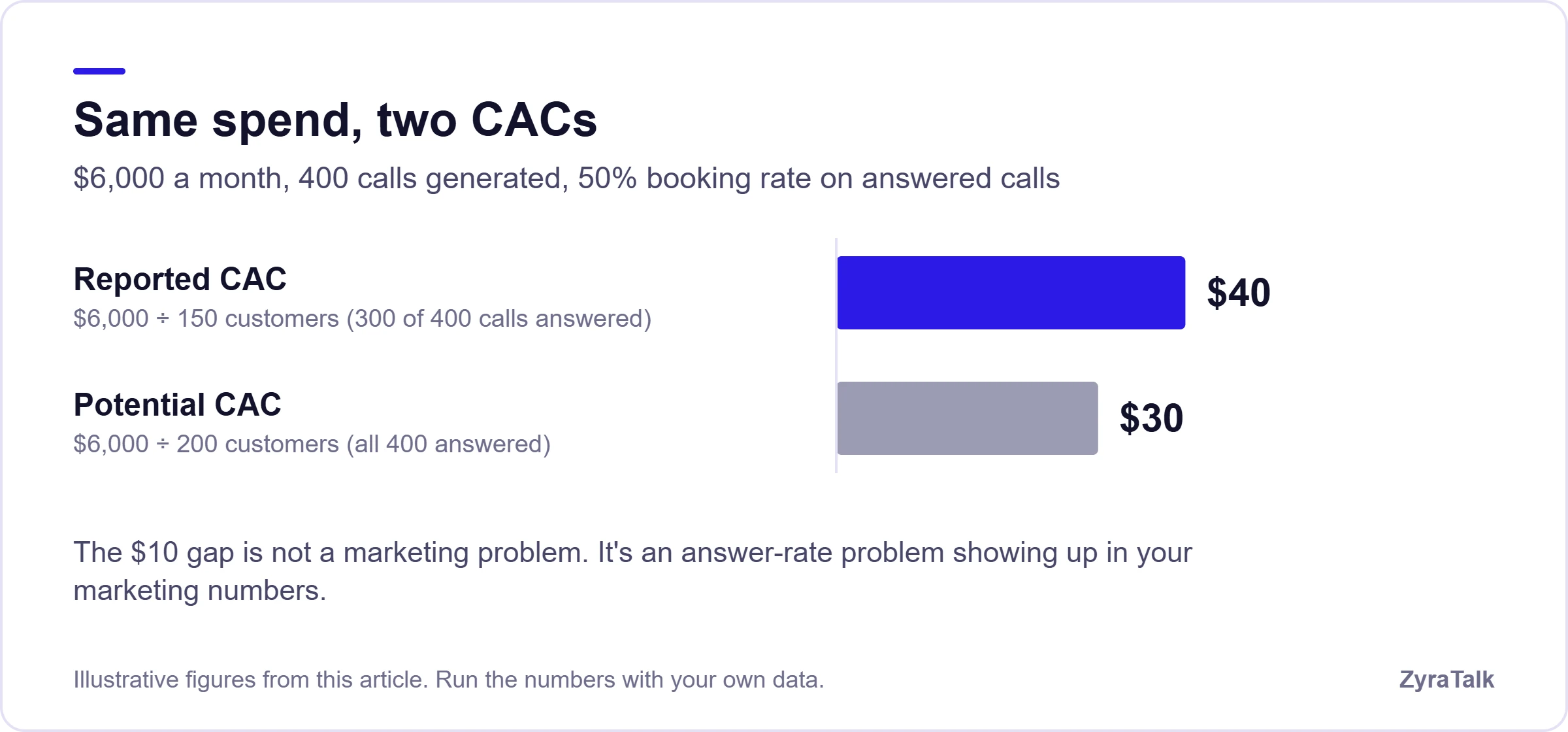
$6,000 monthly spend. 400 calls generated. 300 answered. A 50% booking rate on answered calls gives 150 new customers.
Reported CAC: $6,000 ÷ 150 = $40
If all 400 calls had been answered at the same booking rate, that is 200 customers. Potential CAC: $30.
The $10 difference is not a marketing problem. It is an answer-rate problem showing up in your marketing numbers, and it makes every channel look 33% worse than it is.
The practical implication is uncomfortable for anyone about to increase ad spend: if your answer rate is low, buying more leads makes your CAC worse, because you are adding volume to a funnel that already leaks at the top.
Adjustment 2: calculate it per channel
Blended CAC is an average across channels with wildly different economics, and averages conceal exactly the information you need. Referrals may be costing you $40 while a shared-lead marketplace is costing you $700, and the blended number tells you neither.
Home service channels behave very differently:
| Channel | How CAC behaves | What to watch |
|---|---|---|
| Referrals | Lowest CAC of any channel, often just an incentive cost. | Requires actually asking and recording lead source. |
| Organic search / SEO | High upfront, near-zero marginal cost once ranking. Payback 6–18 months. | CAC looks infinite in month one. Judge on a 12-month window. |
| Local Services Ads | Charges per lead, high intent, generally the strongest paid channel for the trades. | Dispute bad leads. Most contractors under-use this. |
| Google Ads (search) | Predictable and scalable; CAC rises as you push volume. | Cost per click climbs sharply in peak season. |
| Shared-lead marketplaces | Same lead sold to several contractors. Effective CAC is a multiple of lead price. | Speed to lead decides everything here. |
| Social / display | Lower intent, higher CAC than search. Better for remarketing. | Do not judge on last-click attribution alone. |
The marketplace case deserves special attention. When Angi or Thumbtack sells the same lead to four contractors, you are not paying for a customer. You are paying for a one-in-four chance at one, and your actual odds depend almost entirely on whether you respond first. A contractor who answers immediately might convert 40% of those leads; one who calls back in two hours might convert 10%. Same lead price, a fourfold difference in CAC, decided entirely by response speed.
Adjustment 3: handle seasonality
Every general CAC guide implicitly assumes flat demand. The trades do not have flat demand.
An HVAC company's CAC in the first heat wave and its CAC in a mild October are different numbers describing different market conditions. Click costs rise in peak season, but conversion rates rise faster, so peak CAC is often lower despite higher spend. Calculating an annual blended figure averages these into a number that describes neither, and can lead you to cut spend in exactly the months when it performs best.
Calculate monthly, review quarterly, and compare each month against the same month last year rather than against the month before.
Reading CAC against lifetime value
CAC in isolation means nothing. A $600 CAC is excellent for a roofing company and ruinous for a cleaning service. The comparison that matters is customer lifetime value.
The general literature quotes a 3:1 LTV to CAC ratio as healthy, borrowed from subscription software. It is a reasonable starting point, but home services differ in one important respect: your customer is transactional, not subscribed. They do not churn out of a contract; they simply may or may not call you again. That makes lifetime value harder to estimate and more sensitive to retention work.
A workable approach:
1. Estimate average jobs per customer over three years. Pull it from your invoicing history rather than guessing.
2. Multiply by average ticket to get a three-year revenue figure.
3. Apply your gross margin to get contribution rather than revenue.
4. Compare that against CAC.
If a plumbing customer averages 2.5 jobs at $450 over three years with a 45% gross margin, their contribution is about $506. A $300 CAC against that is workable but not comfortable; a $150 CAC is a good business. Judging that same $300 CAC against a single $450 invoice would have made it look far worse than it is, which is how businesses talk themselves out of channels that are actually working.
How often to calculate it
- Monthly: per channel, as an operating number.
- Quarterly: blended, with a look at trend and seasonality.
- Annually: against lifetime value, to check the whole model still holds.
Where ZyraTalk fits
ZyraTalk does not lower your cost per lead. It changes the denominator. By answering calls that currently ring out, after hours, during peak season, and when the office is on another line, more of the leads you already paid for become customers. Because CAC is spend divided by customers, raising the answer rate lowers CAC across every channel at once, without buying a single additional lead. For contractors buying shared marketplace leads, where response speed determines who wins a lead sold to several companies, the effect is larger still.
The CAC formula is not the hard part. The hard part is being honest about the denominator, and for most home service businesses the fastest way to improve the number is not cheaper leads. It is answering the ones you already have.
You already paid for those calls
ZyraTalk answers the leads your budget already generated for HVAC, plumbing, electrical, cleaning and painting businesses, which pulls CAC down on every channel at the same time.
Book a demo- No extra ad spend required
- First to respond on marketplace leads
- Every call logged and measurable
Customer acquisition cost FAQs
How do you calculate customer acquisition cost?
Divide total sales and marketing costs for a period by the number of new customers acquired in that period. Include ad spend, lead fees, agency costs, marketing software, and the labor cost of handling leads.
What is a good CAC for a home service business?
It depends entirely on your average ticket and how often customers return. Rather than chasing an industry figure, compare your CAC against your customer's three-year contribution margin. A ratio of roughly 3:1 or better is a reasonable target.
What's the difference between CAC and cost per lead?
Cost per lead is what you pay for an inquiry. CAC is what you pay for a customer. The gap between them is your booking and close rate, which means a business with a poor answer rate has a fine CPL and a bad CAC.
Should I include salaries in CAC?
Include the portion of wages spent on acquiring customers: lead handling, quoting and follow-up. Exclude the cost of performing the work, which is cost of goods sold.
Why is my CAC so high on Angi and Thumbtack?
Because those leads are sold to several contractors simultaneously, so you are buying a fraction of a chance rather than a customer. Your effective CAC on marketplace leads is decided mostly by how fast you respond, since the contractor who calls back first converts a large share of them.
How does answering more calls affect CAC?
Directly and immediately. CAC is spend divided by customers, so converting more of the calls your existing spend already generates lowers CAC across every channel at once, without increasing the marketing budget.