
Call abandonment rate is the percentage of inbound callers who hang up before reaching anyone. Published benchmarks put an acceptable rate near 5%, but those numbers come from staffed call centers with hold queues. A home service business with no queue and crews in the field often runs far higher, and unlike a call center, each abandoned call is a specific job with a knowable dollar value.
What is call abandonment rate?
Call abandonment rate is the percentage of inbound calls where the caller hangs up before reaching a person. The formula is straightforward:
Example: 400 inbound calls in a month, 84 of which ended before anyone answered. 84 ÷ 400 = 0.21, or a 21% abandonment rate.
In the call-center world the metric measures queue health: callers waiting on hold who give up. Most published guidance treats abandonment as a symptom of understaffing, long hold times, or a confusing phone menu. SQM Group, which benchmarks contact centers, puts the industry average near 5%, treats anything under 5% as good, considers 5% to 10% acceptable depending on circumstances, and finds that centers with the strongest customer satisfaction scores tend to sit at 3% or below.
Why that benchmark does not apply to your business
Here is the problem with every ranking article on this topic: they all assume you have a hold queue. A call center has automatic call distribution, agents in seats, a service-level target, and callers waiting in line. A five-person HVAC company has a phone that rings while everyone is on a roof.
When the standard literature calls 5% acceptable, it is describing a business whose entire operating model is answering phones. Applying that number to a field service business produces one of two wrong conclusions: either you decide you are catastrophically failing, or you decide the metric is irrelevant. Neither is useful.
The honest version: in the trades, abandonment and non-answer collapse into the same event. There is no queue to abandon. The caller rings, nobody picks up, and they either leave a voicemail, call back later, or, most often, call your competitor. Rates of 20–40% are common in small field businesses, and the fix is not queue management. It is coverage.
- Abandonment rate is calculated the same way everywhere, but the benchmarks are not transferable.
- Published targets near 5% describe staffed call centers with queues, not field service businesses.
- For the trades, the more useful metric is simply the answer rate: what share of inbound calls reach a human.
- Most abandoned calls do not leave voicemail, so voicemail volume badly understates the problem.
- Each abandoned call has a knowable revenue value: your average ticket multiplied by your booking rate.
How to measure it without call-center software
You do not need an enterprise platform. Three practical sources:
1. Your phone carrier's call log. Nearly every business line, VoIP or mobile, produces a record of inbound calls including unanswered ones. Export a full month.
2. Call tracking software. If you run tracking numbers on your marketing, answered versus missed is already reported, and usually broken out by source.
3. Your field service platform. Some systems log call activity, though coverage varies and after-hours calls are frequently the gap.
Pull thirty days, count total inbound and unanswered, and divide. Then do the part most businesses skip: segment by hour and day. A blended monthly rate hides the pattern. Nearly every home service business finds their misses cluster in two windows, after hours and weekends, and midday when the office is on another line. Knowing which of those dominates determines what you actually need to fix.
Why customers don't leave voicemails
Owners often reason that a missed call is not really lost because the customer can leave a message. The voicemail box is comparatively empty, which gets read as evidence that missed calls are rare.
It is evidence of the opposite. Most callers who reach voicemail simply hang up, for reasons that are entirely rational from their side:
- They have alternatives. They found you in a list of search results with two more contractors directly below you. Redialing the next number takes eight seconds; leaving a message and waiting takes an unknown number of hours.
- The problem is time-sensitive. Someone with a failing water heater is not looking to open a correspondence. They need it handled today.
- Voicemail feels like a dead end. There is no confirmation anyone will hear it, and no indication of when. Many people simply do not use voicemail anymore in any context.
- They are calling from a job site, a car, or a hallway. Leaving a coherent message with an address and a description takes focus that the moment often does not allow.
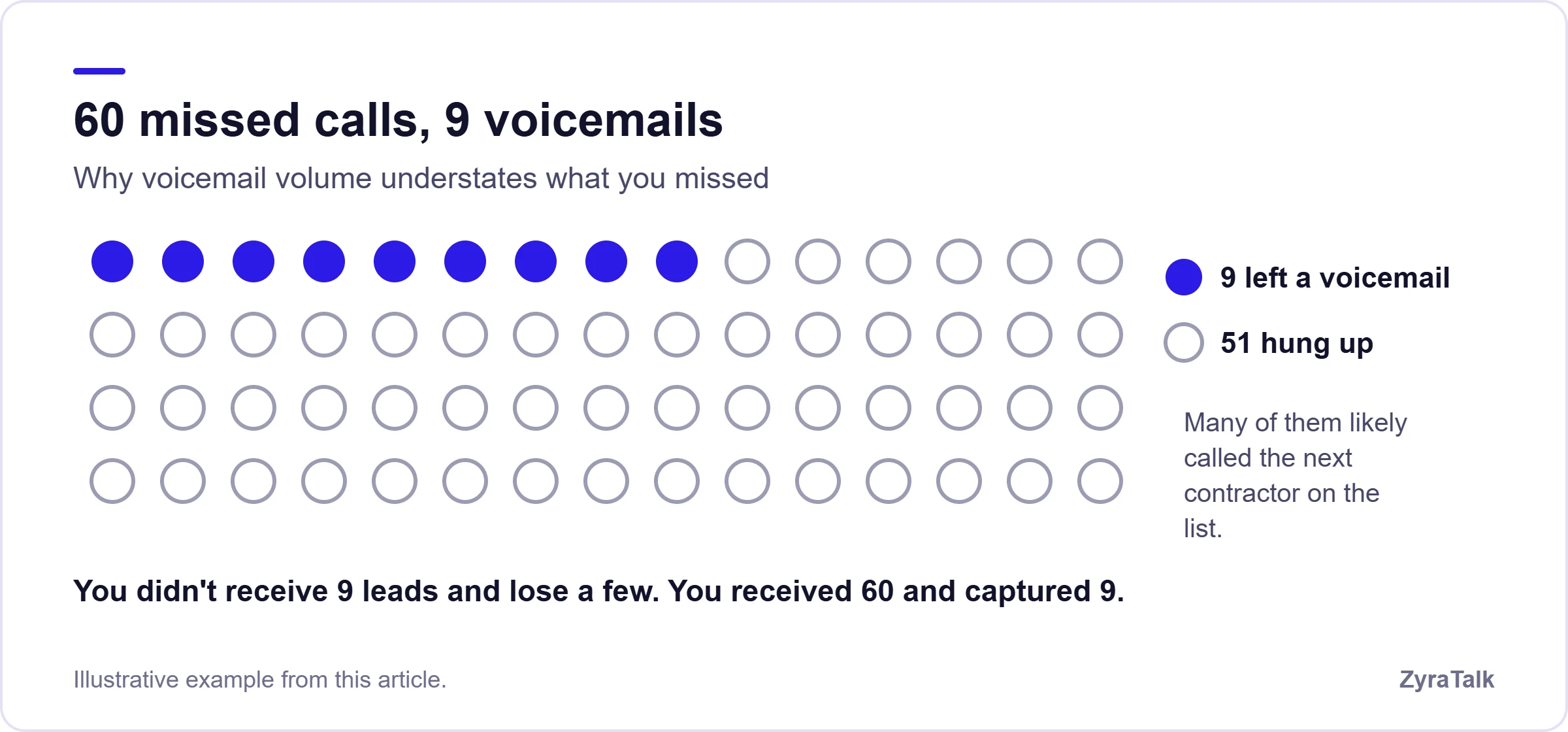
The practical consequence: voicemail volume is a poor proxy for missed opportunity. If you have 60 missed calls and 9 voicemails, you did not receive 9 leads and lose a few. You received 60 leads and captured 9.
Why customers hang up before booking
A related failure happens on calls that are answered. The phone gets picked up and the caller still leaves without a booking. Common causes in the trades:
- Hold. Small offices put callers on hold to check a schedule or find an answer. Tolerance for hold when three competitors are one tap away is very short.
- Phone menus. An IVR built for a business with five departments, applied to a business with one office manager, adds friction with no routing benefit.
- The person answering cannot book. If the call ends in "I'll have someone call you back with times," the booking has been deferred into a second contact that frequently never happens.
- No answer on price. Callers routinely ask for a ballpark. "We can't say until we see it" is sometimes accurate and always unsatisfying, and a range plus an explanation converts better than a refusal.
- Wrong first question. Opening with a demand for full contact details before acknowledging the problem reads as bureaucratic. Acknowledge the issue first.
What abandonment costs
Convert the percentage into money and the priority usually resolves itself. The arithmetic:
A plumbing company taking 400 calls a month with a 21% abandonment rate misses 84 calls. If they book roughly half of the calls they do answer, and their average ticket is $450, that is 42 jobs and about $18,900 per month, or roughly $225,000 a year, sitting in unanswered rings.
Run this with your own numbers. The illustration is only as good as the inputs.
The reason this framing matters is that it changes the comparison. Coverage, whether that is an answering service, an after-hours rotation or an AI receptionist, always looks like a cost when measured against zero. Measured against the revenue currently ringing out, the comparison is usually not close.
How to bring the rate down
1. Find the two windows. Segment your misses by hour and day before buying anything. The fix for after-hours misses is different from the fix for midday misses.
2. Cover after hours deliberately. On-call rotation, live answering service, or AI answering. Voicemail is not coverage; it is a recording device.
3. Handle simultaneous calls. During peak season several calls arrive at once. A single line and a single person guarantees abandonment regardless of effort.
4. Let whoever answers actually book. Give them the schedule and the authority. A call that ends in a booking cannot be lost in a callback.
5. Strip unnecessary menu layers. If you have one office, callers should reach it, not a menu.
6. Add text-back as a backstop. It will not prevent the miss but it keeps a fraction of them alive.
How ZyraTalk helps
ZyraTalk answers every inbound call instantly, including several at once during a seasonal surge and including nights and weekends, so calls do not ring out in the first place. It qualifies the caller, books the job directly into your field service software, and escalates real emergencies to your on-call tech. Every call is logged with a transcript, which also means you finally get a reliable answer rate to measure instead of an estimate.
Call abandonment rate is a genuinely useful number for a home service business. It is just not the number the call-center literature is describing. Measure your own answer rate, find the two windows where the misses cluster, and price the gap against your average ticket. The decision usually makes itself.
Your crews are on roofs. Something still has to answer.
ZyraTalk picks up every call for HVAC, plumbing, electrical, cleaning and painting businesses, even when four come in at once on the first cold snap of the year.
Book a demo- Answers simultaneous calls
- Books straight into your schedule
- Gives you a real answer rate to track
Call abandonment rate FAQs
What is a good call abandonment rate?
For a staffed call center, SQM Group puts the benchmark average near 5% and treats 5% to 10% as acceptable, with top performers at 3% or below. For a small home service business with no hold queue there is no published standard. The practical target is to answer as close to 100% of inbound calls as your coverage allows, because every abandoned call is a job going to a competitor.
How do I calculate call abandonment rate?
Divide abandoned calls by total inbound calls and multiply by 100. Pull the numbers from your phone carrier's call log or call tracking software, and segment by hour and day of week rather than relying on a single blended figure.
What's the difference between abandoned and missed calls?
In call-center terms, abandoned means the caller left a hold queue while missed means nobody was available. In a home service business without a queue the two collapse into one event: the phone rang and nobody picked up.
Should I exclude calls abandoned in the first few seconds?
Call centers commonly exclude calls dropped within the first 5 to 10 seconds as misdials, and SQM Group estimates these false abandons account for up to 2% of call volume. It is a reasonable adjustment, but do not use it to flatter the number. In a small business the volume of true misdials is low.
Does voicemail count as an abandoned call?
If the caller reached voicemail instead of a person, the call was not answered. Whether or not they left a message, it belongs in your abandonment count. Voicemails left are a subset of the problem, not a measure of it.
Why is my abandonment rate so much higher than the call-center benchmark?
Because that benchmark describes a business whose staff sit at phones all day. If your team is in the field, a substantially higher rate is normal, which is a coverage finding rather than a performance failure by whoever answers your phone.