

Call booking rate is the percentage of answered calls that end in a scheduled job. It is the clearest measure of how well your phone conversations convert, and unlike most metrics, a low number usually points at something structural you can fix this week rather than at how hard your team is trying.
What is call booking rate?
Call booking rate is the share of answered inbound calls that result in a booked appointment or job.
Example: 220 bookable calls answered in a month, 132 of which ended with something on the calendar. 132 ÷ 220 = 60%.
Note the word bookable in the denominator. That single qualifier is the difference between a metric you can manage and a number that drifts for reasons nobody can explain.
Building a denominator that means something
The most common mistake is dividing bookings by every answered call. That denominator includes calls that were never going to become jobs, which drags the rate down for reasons unrelated to performance and makes month-to-month comparison meaningless.
Exclude from the denominator:
- Vendor and sales solicitations. Someone selling you insurance is not a lead.
- Wrong numbers and misdials.
- Existing customers calling about a scheduled job: status checks, ETA questions, invoice queries.
- Out-of-area callers you cannot serve.
- Calls for work you do not do, such as a plumbing company getting an HVAC request.
- Job applicants.
What remains is a genuine prospect asking about work you can do in a place you serve. That is the population your booking rate should describe. In most home service businesses, stripping these out moves the denominator by 15–30% and the resulting rate is a substantially different number.
- Booking rate measures conversation quality; answer rate measures coverage. They are different problems with different fixes.
- A correct denominator counts only bookable calls: genuine prospects for work you do in an area you serve.
- Segment by lead source, time of day, trade and individual CSR. A blended number hides every actionable finding.
- Most low booking rates are structural rather than motivational. Schedule access, quoting authority, hold time and menu friction account for more than effort does.
- After-hours calls behave differently from business-hours calls and should be measured separately.
What good looks like
There is no credible published benchmark for this metric in home services, and any article quoting a precise industry figure should be treated with suspicion. What can be said with confidence is how the number behaves:
- Emergency and diagnosed-problem calls book high. Someone with an active leak has already decided to hire someone; the only question is who. Booking rates on urgent calls are typically the highest in the business.
- Quote and estimate calls book lower. The caller is shopping, and the booking is for a visit rather than the work itself.
- Referral calls book highest of any source. Trust is pre-established.
- Shared-marketplace leads book lowest. The caller is talking to several contractors by design.
- Repeat customers book near-automatically, which is why they should be excluded from the denominator when they are calling about existing work, but counted when they are calling about new work.
The useful benchmark is your own trend, and the spread between your best and worst performers. If one CSR books 70% of bookable calls and another books 45% on the same lead mix, that gap is worth more attention than any industry average.
What to segment by
| Segment by | What a gap tells you |
|---|---|
| Lead source | Which channels send prospects who actually convert. A channel with low cost per lead and a low booking rate may be worse than an expensive one. |
| Time of day | Midday dips usually mean the office is overloaded. After-hours gaps mean coverage, not skill. |
| Individual CSR | The internal spread is almost always the largest single opportunity, and it is coachable. |
| Job type | If replacement inquiries book far below service calls, the issue is likely the pricing conversation rather than phone technique. |
How to increase booking rate
Most advice on this topic reduces to "train your CSRs." Training matters, but structural causes are more common and easier to fix. Start with those.
1. Give whoever answers access to the schedule
If the person on the phone cannot see availability, the call cannot end in a booking. It ends in "someone will call you back with times," which defers the booking into a second contact that frequently never happens. This is the single most common structural cause of a low booking rate and it is a permissions problem, not a people problem.
2. Give them authority to quote a range
Callers ask what it costs. "We can't say until we see it" is often technically true and always unsatisfying, and the caller's next move is to ask someone who will answer. A defensible range with an explanation, such as "most jobs like this run $300 to $600 depending on what we find," converts substantially better than a refusal.
3. Cut hold time to near zero
Putting a caller on hold to check something is a small act with a large cost when three competitors are one tap away. If a hold is unavoidable, keep it under thirty seconds and say why.
4. Remove menu layers you do not need
An IVR designed for a company with departments, applied to a company with one office manager, adds friction and delivers no routing benefit. If callers should reach one place, send them there.
5. Acknowledge the problem before collecting data
Opening with a demand for name, address and phone number before responding to what the caller said reads as bureaucratic. Acknowledge the issue, ask one diagnostic question, then collect details. The sequence matters more than most people expect.
6. Ask for the booking explicitly
A surprising share of calls end informationally: the caller gets their answer and hangs up without being offered a slot. "I've got Thursday morning or Friday afternoon, which works better?" is a different call than "let us know if you'd like to schedule." Offer two specific times.
7. Fix the after-hours experience separately
A caller at 9 p.m. is in a different situation from one at 10 a.m. If your after-hours answer is voicemail, your after-hours booking rate is effectively zero regardless of how good your daytime team is. Measure the two separately or the good number will hide the bad one.
8. Then coach on the calls themselves
Once the structural blockers are gone, call review is genuinely valuable. Listen to a sample each week, compare a high performer against a low one on the same lead type, and coach on specifics rather than generalities.
Diagnosing a low booking rate
| Symptom | Most likely cause | First thing to try |
|---|---|---|
| Rate drops midday | Office overloaded; simultaneous calls | Add coverage in the peak window |
| Rate low across the board | Structural: no schedule access or quoting authority | Grant permissions before training |
| Wide gap between CSRs | Skill and confidence variance | Call review; pair the low performer with the high one |
| Low on one lead source only | Lead quality or intent mismatch | Re-examine that channel's cost per lead against its booking rate |
| Low on estimates, fine on service | Pricing conversation | Build and authorize a quoting range |
| Near zero after hours | No coverage | Answering service, on-call rotation, or AI answering |
Booking rate and answer rate together
These two metrics multiply, and it is worth seeing them side by side because improving the wrong one wastes effort.
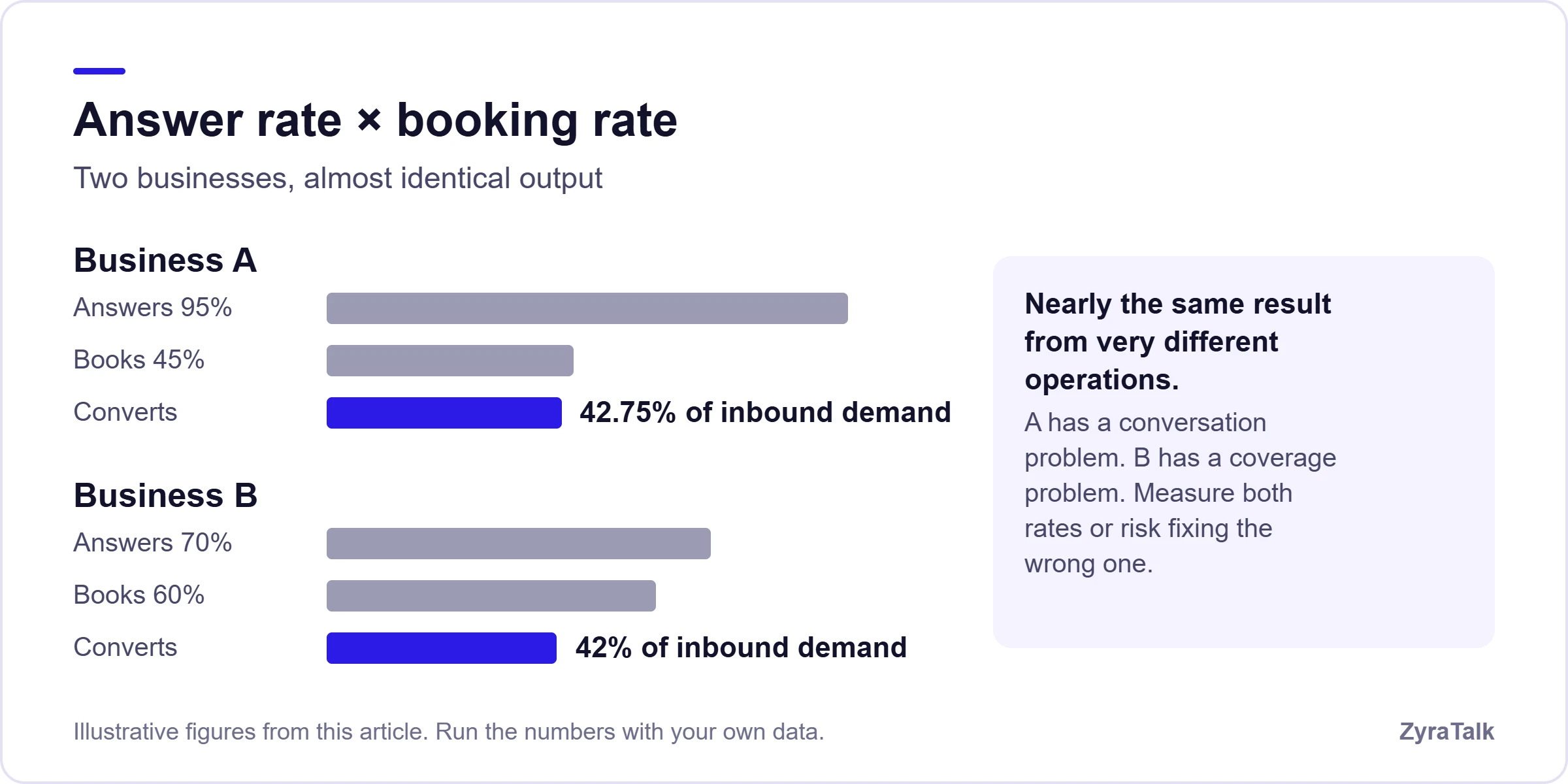
A business answering 95% of calls and booking 45% converts 42.75% of inbound demand. A business answering 70% and booking 60% converts 42%. Nearly identical outcomes from very different operations, and the fixes are completely different. The first business has a conversation problem; the second has a coverage problem. Measuring only one of the two numbers means having a fifty-fifty chance of working on the wrong thing.
How ZyraTalk helps
ZyraTalk affects both sides of that multiplication. It answers every call including after hours and simultaneous peak-season calls, and because it books directly into your field service software, the call ends with something on the calendar rather than a promise to call back. It also transcribes and logs every call, which makes booking rate measurable by source, by time and by call type without anyone manually reviewing recordings.
Booking rate is one of the few metrics where the diagnosis usually points at something you can change quickly. Build an honest denominator, segment it four ways, and fix the structural causes before coaching the conversations. Most of the gap is usually sitting in permissions and process rather than in performance.
The call should end on the calendar
ZyraTalk sees your availability, offers real times, and writes the booking into your field service software for HVAC, plumbing, electrical, cleaning and painting businesses.
Book a demo- No callbacks, no phone tag
- Booking rate measurable by source and time
- After-hours calls handled the same way
Call booking rate FAQs
What is call booking rate?
The percentage of answered, bookable inbound calls that result in a scheduled appointment or job. It measures how well phone conversations convert, as distinct from answer rate, which measures whether calls are reached at all.
How do I calculate call booking rate?
Divide jobs booked by bookable calls answered, then multiply by 100. Exclude solicitations, wrong numbers, out-of-area callers, job applicants and existing customers calling about scheduled work, because including them makes the number drift for reasons you cannot act on.
What's a good call booking rate?
No credible published benchmark exists for home services, and it varies sharply by call type, since emergency calls book far higher than estimate requests. Track your own trend and the spread between individual CSRs, which is usually the most actionable comparison available.
What's the difference between booking rate and close rate?
Booking rate is the share of calls that become scheduled visits. Close rate is the share of estimates that become sold work. Booking gets the truck to the house; closing sells the job.
Why is my booking rate low?
Most often for structural reasons rather than effort. Whoever answers cannot see the schedule, cannot quote a range, or has to put callers on hold. Check those before assuming it is a training issue.
Should I measure after-hours booking rate separately?
Yes. After-hours calls arrive in different circumstances and, if your after-hours coverage is voicemail, the rate is effectively zero. Blending it into a single number hides both the problem and the opportunity.