

The ROI case for an answering service is simpler than most vendors make it. Work out what your missed calls are worth, work out what the service costs, and calculate how many recovered jobs cover the fee. For most home service businesses that break-even number is one or two jobs a month, which is why the decision usually turns on whether you believe the miss-rate figure rather than on the arithmetic.
Start with the right comparison
Most ROI pages in this category compare an answering service against hiring a full-time receptionist. That framing flatters the service, since of course a monthly fee beats a salary, but it is not the decision most home service owners are weighing.
The real comparison is against voicemail. Against doing nothing. The question is not whether this is cheaper than an employee, but whether the revenue it recovers is larger than what it costs. That is a harder case to make and a more honest one, so it is the one worth making.
The break-even calculation
If the service costs $400 a month, your average ticket is $450 and your gross margin is 45%, then each recovered job contributes about $202. $400 ÷ $202 = just under two jobs a month to break even.
Use margin rather than revenue. Recovering a $450 job does not put $450 in your pocket. It puts your gross margin on that job in your pocket. Vendor calculators that use full revenue overstate the return, and any owner who has run a business will notice.
The reason this framing is persuasive is that the break-even number is usually small. Most owners can look at their missed-call volume and form a quick judgment about whether two additional jobs a month is plausible. If the answer is obviously yes, the decision is largely made.
Worked example
A plumbing company:
- Inbound calls per month: 400
- Currently unanswered: 84 (21%)
- Booking rate on answered calls: 50%
- Average ticket: $450
- Gross margin: 45%, giving a contribution per job of $202
- Answering service cost: $400 per month
If the service answers those 84 previously-missed calls and books them at the same 50% rate, that is 42 additional jobs a month. Against a break-even of two jobs, the case is not close.
But that assumes perfect recovery, which is exactly the kind of assumption that makes owners distrust vendor math. So run it three ways.
Sensitivity: three scenarios
| Assumption | Conservative | Moderate | Optimistic |
|---|---|---|---|
| Share of missed calls now answered | 50% | 75% | 95% |
| Missed calls recovered (of 84) | 42 | 63 | 80 |
| Booking rate on recovered calls | 35% | 45% | 50% |
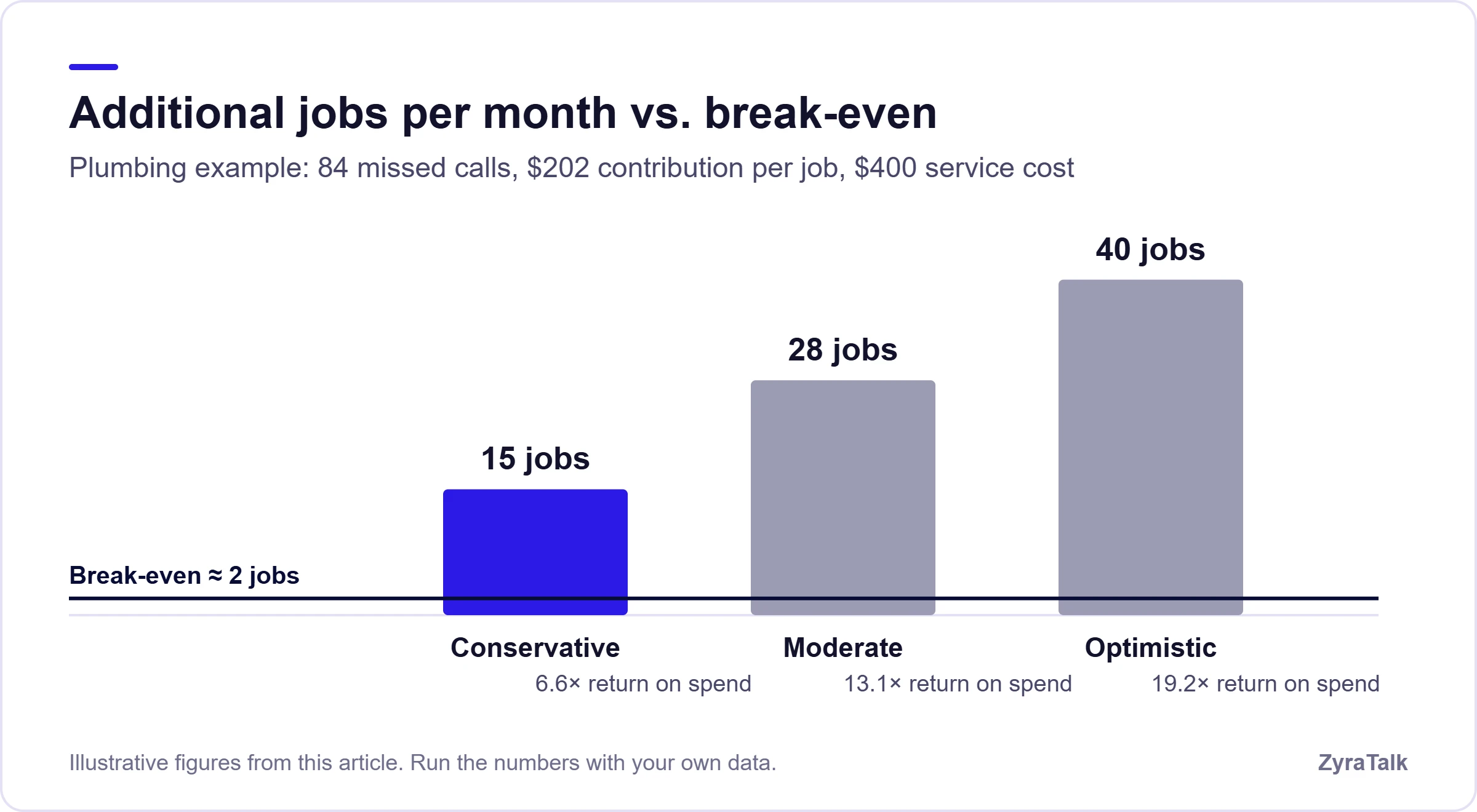
| Additional jobs per month | 15 | 28 | 40 |
| Contribution added ($202/job) | $3,030 | $5,656 | $8,080 |
| Less service cost ($400) | $2,630 | $5,256 | $7,680 |
| Return on spend | 6.6× | 13.1× | 19.2× |
The conservative column is the one that matters. If the case only works under optimistic assumptions, it is not a case. Here it holds comfortably even when you assume the service answers only half the missed calls and books them at a lower rate than your own team does, which is a deliberately pessimistic pair of assumptions.
Why the booking rate assumption is lower
You will notice the conservative scenario assumes recovered calls book at 35% against your team's 50%. That is intentional, and worth explaining rather than hiding: after-hours and overflow calls are not identical to the calls your team handles at 10 a.m. Some are price-shoppers, some are wrong-trade, some have already booked someone else. Modelling them at the same rate as your best calls overstates the return.
Being explicit about this is what makes the rest of the arithmetic credible.
Returns that do not show up in the math
These are real but harder to quantify, so keep them separate from the calculation rather than folding them in to inflate it:
- The owner stops being the after-hours answering service. In a lot of small operations the owner's mobile is the overflow line. The value of not fielding calls at 9 p.m. is genuine and does not appear in any spreadsheet.
- Peak season stops being a bottleneck. The days with the highest call volume are the days you currently miss the most. Coverage disproportionately helps when demand is highest.
- You finally get reliable data. Most businesses cannot state their answer rate or booking rate accurately. Call logs and transcripts make both measurable, which improves every subsequent decision.
- Marketing spend works harder. Every channel's cost per booked job falls when the answer rate rises, without renegotiating a single lead price.
- Fewer leads lost to competitors permanently. A homeowner who books with a competitor is not just one lost job. They now have a plumber.
When the ROI does not hold
Any page claiming universal returns should be treated with suspicion. The cases where the answer is genuinely no:
- You already answer nearly every call. If your miss rate is low and you have no after-hours volume, there is little to recover. Measure before assuming.
- Very low call volume. A business taking twenty calls a month cannot recover enough to clear the fee, even at excellent rates.
- Very low ticket and thin margin. If contribution per job is $40, break-even climbs to ten jobs a month and the case becomes marginal.
- Calls that genuinely require deep expertise. If a routine call in your business still needs the senior tech's judgment to scope, the recovery rate will be lower than the model assumes.
- Nobody will configure it. These services reward setup effort. Deployed carelessly and left to drift out of date, the return degrades quickly.
The honest version: this is a strong case for a business with meaningful call volume, a real miss rate and a decent ticket. It is a weak case for a very small operation that already answers its phone.
How to build the case for yourself
1. Pull thirty days of call data. Carrier logs or call tracking. Count inbound and unanswered.
2. Get your booking rate from answered calls that became jobs.
3. Get your contribution per job: average ticket times gross margin, not revenue.
4. Calculate break-even: monthly cost divided by contribution per job.
5. Run the conservative scenario. If it works there, it works.
6. Re-measure after ninety days against the same call data, so you are comparing like with like.
How ZyraTalk fits
ZyraTalk answers every inbound call, after hours, on weekends and several at once during peak season. It qualifies the caller and books directly into your field service software. Because every call is logged and transcribed, you also get the measurement needed to check the ROI case honestly after the fact rather than taking it on faith at the point of sale.
The ROI case for answering every call is unusual in that it does not depend on optimistic assumptions. Work out your break-even, run the conservative scenario, and if the numbers only work when you are generous with them, do not buy.
Two jobs a month. That's usually the whole case.
Bring your call volume, booking rate and average ticket to a demo and we'll build the break-even with you, using the conservative assumptions rather than the flattering ones.
Book a demo- Margin-based math, not revenue math
- Every call logged so you can verify it later
- Built for plumbing, HVAC, electrical and cleaning
Answering service ROI FAQs
How do you calculate the ROI of an answering service?
Divide the monthly cost by your contribution per job, which is average ticket times gross margin, to get your break-even in jobs. Then estimate how many additional jobs the service will produce from calls you currently miss, and compare. Use margin rather than revenue or the return will be overstated.
How many jobs does an answering service need to recover to pay for itself?
For most home service businesses, one or two a month. On a $400 monthly cost with a $450 average ticket and 45% margin, break-even is just under two jobs.
Is an answering service worth it for a small business?
It depends on your call volume, miss rate and ticket size. It is a strong case for a business missing a meaningful share of calls with a decent average ticket, and a weak one for a very small operation that already answers nearly every call. Measure your miss rate before deciding.
Should I use revenue or margin in the calculation?
Margin. A recovered job contributes its gross margin, not its full invoice value. Calculators that use revenue overstate the return substantially.
How long does it take to see a return?
Usually within the first month or two, because the break-even job count is low. What takes longer is having enough data to verify it, so allow ninety days before judging and compare against the same call-data source you used at the start.
What if the service books fewer jobs than my own team?
Assume it will. After-hours and overflow calls convert at lower rates than your best business-hours calls. Build your case using a lower booking rate for recovered calls, and if it still clears break-even comfortably, the decision is sound.